
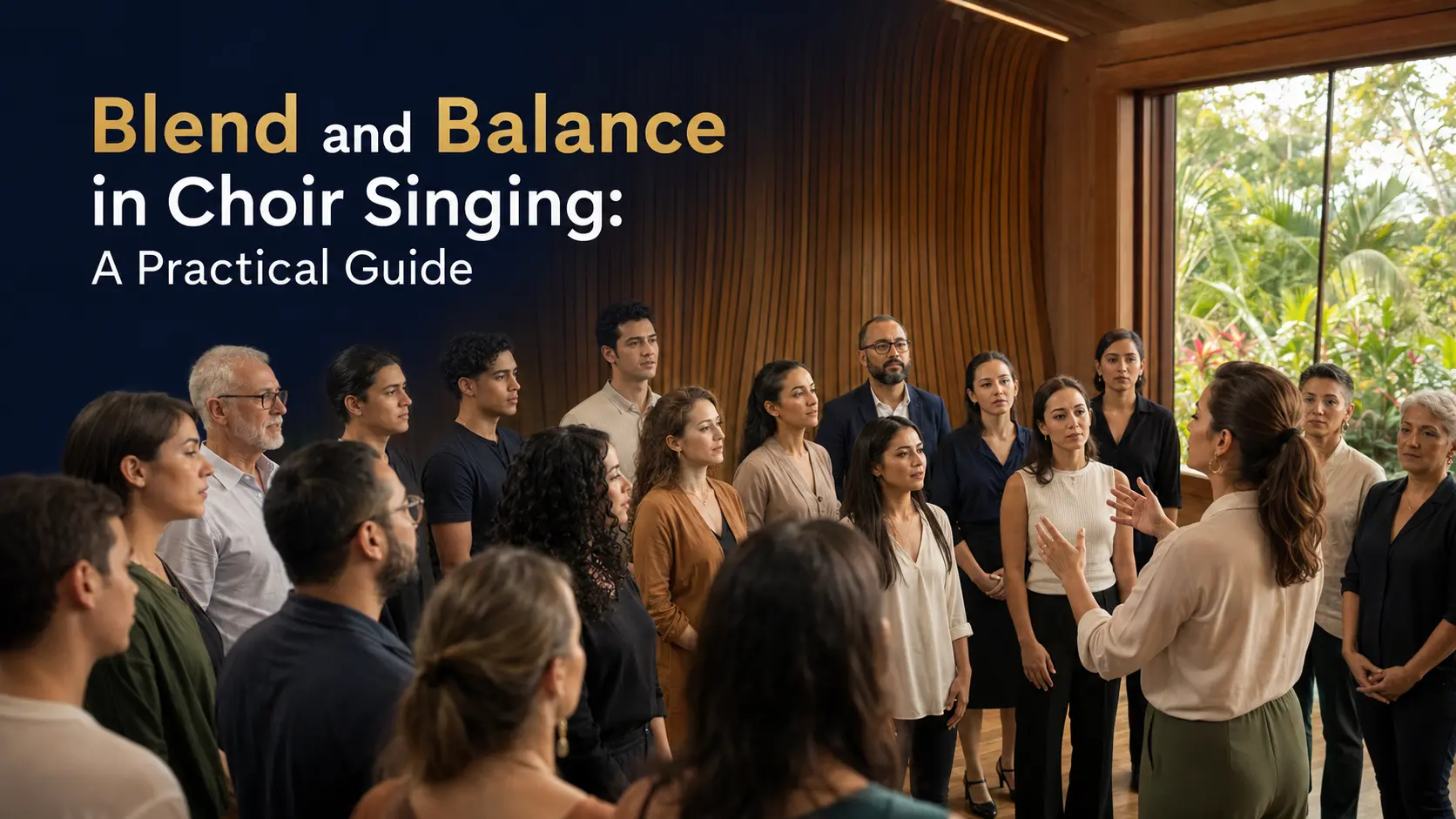
Blend and balance in choir singing help individual voices become a unified ensemble without erasing the natural character of each singer. Blend refers to how vocal colors combine, while balance describes the relationship among sections, musical lines and dynamic levels.
This practical guide explains how choirs can improve vowels, tone, intonation, section balance, diction and listening. It also shows how directors can create a cohesive sound without encouraging unhealthy vocal production or forcing every singer to sound identical.
Effective choir blend and balance depend on healthy vocal production, unified vowels, clear diction, active listening and an understanding of each section’s musical role.
Choir Blend and Balance at a Glance
| Element | Meaning | Main goal |
|---|---|---|
| Blend | How individual vocal colors combine | Create a unified ensemble sound |
| Balance | The relative strength of sections and musical lines | Make important material clearly audible |
| Vowel matching | Coordinating vowel shape and resonance | Improve tuning and tone consistency |
| Diction | Coordinating consonants and text | Increase clarity and rhythmic unity |
| Intonation | Singing pitches accurately in relation to the ensemble | Create stable chords and intervals |
| Dynamic control | Adjusting intensity without forcing | Support musical hierarchy and expression |
| Section awareness | Understanding each part’s role | Prevent melody, harmony or bass lines from being covered |
| Listening | Hearing beyond one’s own voice | Respond continuously to the complete choir |
What Is Choir Blend?
Strong choir blend and balance begin with understanding that blend is about coordination, not making every singer sound identical.
Choir blend is the way individual voices combine into a shared ensemble sound. A well-blended choir does not sound like unrelated singers competing for attention.
Blend depends on several coordinated elements:
- vowel shape;
- resonance;
- volume;
- vibrato;
- articulation;
- timing;
- pitch;
- phrasing;
- listening.
Blend does not mean that every singer must have the same voice. A choir can sound unified while preserving healthy individual vocal production.
What Is Choir Balance?
In practical rehearsal terms, choir blend and balance work together: one shapes the unity of tone, while the other controls which musical lines are most audible.
Choir balance describes the relationship among voice parts and musical lines.
A balanced choir allows listeners to hear the most important material at each moment. This may be:
- the principal melody;
- an inner harmonic line;
- the bass foundation;
- an imitative entrance;
- a dissonance and its resolution;
- important text;
- an instrumental line.
Balance does not always mean equal volume. Different sections may need different levels depending on their musical role.
Choir Blend and Balance Are Not the Same
A choir may blend well but remain poorly balanced. For example, every section may produce a similar tone, yet the soprano section may cover the tenors and altos.
A choir may also be balanced without blending fully. The sections may be heard in the correct proportions, but vowel shape, diction or tone color may remain inconsistent.
Directors must work on both qualities separately and together.
Begin With Healthy Vocal Production
Healthy singing must come before ensemble uniformity.
Singers should not:
- suppress their natural resonance;
- sing breathily to sound smaller;
- force volume to match stronger voices;
- remove all vibrato through tension;
- darken or brighten vowels excessively;
- sing outside a comfortable tessitura.
A unified choir sound grows from coordinated technique, not from physical restriction.
Directors should prioritize healthy technique and avoid forcing singers to suppress natural resonance. The National Institute on Deafness and Other Communication Disorders provides general guidance for caring for the voice.
Match Vowels Before Matching Volume
Vowels carry most of the sustained choral sound. When singers use different vowel shapes, the choir may sound unfocused or out of tune even when the written pitches are correct.
Common Vowel Problems
- one section spreads the “ee” vowel;
- some singers swallow the “ah” vowel;
- “oh” and “oo” become too dark;
- diphthongs change at different times;
- jaw position varies widely;
- vowels lose clarity in the upper range.
Vowel-Matching Exercise
Sustain one chord on:
- ee;
- eh;
- ah;
- oh;
- oo.
Ask singers to adjust gradually until:
- the vowel is recognizable;
- the chord stabilizes;
- no section dominates;
- the tone remains comfortable.
Coordinate Diphthongs
A diphthong contains two vowel sounds within one syllable, such as the vowel in “light” or “day.”
Choirs should agree on:
- which vowel is sustained;
- when the second vowel begins;
- when the final consonant is released.
Most of the note is usually sustained on the first vowel, with the second sound added near the end.
Coordinate Consonants
Consonants influence clarity, rhythm and ensemble precision.
Initial consonants should begin together. Final consonants should release together.
Questions to Decide
- Does the consonant occur before the beat or on the beat?
- Is the final consonant voiced or unvoiced?
- Should a repeated consonant be doubled or connected?
- Which section carries the clearest text?
- How long should the vowel remain before the consonant?
Uncoordinated consonants can make even accurate singing sound untidy.
Listen Across the Choir
Singers often listen only to the person beside them or to their own section.
Better ensemble listening includes:
- the bass foundation;
- the principal melody;
- the neighboring section;
- the complete chord;
- the acoustic response of the room;
- the conductor’s musical direction.
Listening Exercise
Ask each section to identify:
- who has the melody;
- who has the root of the chord;
- where the dissonance occurs;
- which line should be most prominent;
- which section should reduce volume.
Understand the Role of Each SATB Section
In many SATB arrangements:
- Soprano often carries the highest line or melody.
- Alto provides inner harmony and warmth.
- Tenor connects upper and lower sections and may carry important inner movement.
- Bass provides harmonic foundation and direction.
These roles can change from one passage to another.
Our guide to SATB voice parts explains the function of each section in greater detail. For the broader practical framework, see the Complete Guide to Choir Singing.
Protect the Inner Voices
Altos and tenors are frequently covered because sopranos and basses occupy the outer edges of the harmony.
Directors can improve inner-part clarity by:
- reducing soprano volume;
- asking basses to sing with less weight;
- rehearsing altos and tenors together;
- removing the melody temporarily;
- changing choir formation;
- asking singers to identify harmonic function;
- using a lighter tone in outer parts.
Do Not Confuse Volume With Importance
A musical line becomes important through text, harmony, rhythm and phrasing, not only through loudness.
Sections should avoid increasing volume simply because:
- their notes are difficult;
- they feel uncertain;
- another section is louder;
- the pitch is high or low;
- they want to hear themselves.
Insecurity often causes singers to push. Better preparation and listening usually solve the problem more effectively.
Use Dynamic Hierarchy
Dynamic hierarchy means deciding which musical layer should lead and which should support.
A passage may contain:
- primary melody;
- secondary counter-melody;
- harmonic support;
- bass foundation;
- instrumental accompaniment.
Each layer should have an intentional dynamic relationship.
Practical Dynamic Exercise
Ask the choir to sing a passage three ways:
- all sections at equal volume;
- melody clearly above the harmony;
- inner line temporarily emphasized.
Compare the musical effect and decide which version best communicates the score.
Balance High and Low Voices
Higher pitches often project more easily, especially in bright acoustics. Low voices may require clarity and resonance rather than simply more volume.
Directors should consider:
- the number of singers in each section;
- the natural projection of the voices;
- the register of the music;
- room acoustics;
- distance from the audience;
- instrumental accompaniment.
Equal numbers do not automatically create equal sound.
Balance a Small Choir
In a small ensemble, every voice is more exposed.
Useful strategies include:
- choosing repertoire with manageable divisi;
- using flexible standing positions;
- reducing unnecessary vibrato through breath coordination, not tension;
- matching vowels precisely;
- developing strong individual preparation;
- avoiding excessive section volume.
Balance a Large Choir
Large choirs can produce powerful sound, but clarity may decrease.
Directors should focus on:
- consonant timing;
- clear releases;
- section leaders;
- visual contact with the conductor;
- balanced riser placement;
- reduced volume in exposed acoustics;
- precise rhythmic subdivision.
Use Choir Formation Strategically
Standing arrangement changes what singers hear and how sound reaches the audience.
Sectional Formation
Singers stand with their own voice part. This supports confidence and is useful during note learning.
Mixed Formation
Different voice parts stand beside one another. This can improve independence and ensemble awareness.
Semicircle
A semicircle may improve visual contact and shared listening in smaller ensembles.
Alternating Rows
Sections can be distributed to balance strong and developing singers.
No formation is ideal for every choir or venue. Test several arrangements and listen from the audience area.
Blend in Different Choral Styles
Renaissance Polyphony
Independent lines need clarity, balanced imitation and unified vowels. No section should dominate continuously.
Baroque Music
Text, articulation and rhythmic movement are important. Blend should not remove the clarity of individual lines.
Romantic Choral Music
Long phrases and rich harmony may require a warmer and more expansive sound.
Gospel Music
Blend includes stylistic expression, rhythmic energy and cultural understanding. It should not be approached as classical tone with louder volume.
Contemporary Music
Modern repertoire may require changing tone colors, extended techniques, clusters or spoken effects.
Popular A Cappella
Sections may imitate bass, percussion and instruments. Microphone use can change the balance significantly.
Blend in A Cappella Singing
A cappella choirs depend entirely on vocal coordination.
Important skills include:
- stable intonation;
- vowel alignment;
- internal pulse;
- harmonic listening;
- controlled vibrato;
- balanced chord voicing.
Our guide to a cappella vs. accompanied choir compares the demands of both performance formats.
Balance With Piano or Orchestra
Accompanied choirs must balance not only internally but also with instruments.
Consider:
- piano lid position;
- organ registration;
- orchestral dynamics;
- distance between singers and instruments;
- venue acoustics;
- microphone placement;
- text clarity.
Choirs should not solve instrumental imbalance by forcing volume. The conductor and instrumentalists must adjust together.
Use Vibrato Intentionally
Vibrato is a natural part of many healthy voices. Problems arise when it becomes so wide or uneven that pitch and blend are difficult to hear.
Directors should avoid demanding “no vibrato” through physical restriction.
Better approaches include:
- lighter dynamic levels;
- clear breath coordination;
- focused vowels;
- shorter phrases;
- careful tessitura;
- smaller ensemble groupings.
Develop Unified Phrasing
Blend includes musical direction, not only tone color.
Singers should agree on:
- where the phrase begins;
- where it grows;
- where it relaxes;
- where breaths occur;
- how consonants shape the line;
- how the phrase connects to the text.
A choir with unified phrasing often sounds more blended even before tone color is adjusted.
Coordinate Breathing
Unplanned breathing can interrupt the line and weaken balance.
Our guide to breathing techniques for choir singers explains how coordinated breath supports tone, phrasing and ensemble stability.
Section Breathing
All singers breathe at the same marked point.
Staggered Breathing
Singers breathe at different moments to maintain continuous sound.
When using staggered breathing:
- avoid breathing at phrase climaxes;
- do not breathe beside another singer at the same time;
- reenter quietly;
- match the existing vowel and dynamic.
Improve Intonation Through Balance
Reliable choir blend and balance can make tuning easier because singers hear chord relationships more clearly.
Poor balance can make tuning difficult. If one chord tone is too loud, singers may struggle to hear the complete harmony.
For more detailed tuning strategies, see our guide to improving choir intonation.
For stable chords:
- establish the bass foundation;
- reduce excessive thirds;
- listen for open fifths;
- match vowels;
- avoid forcing volume;
- identify dissonance and resolution.
Use Chord-Building Exercises
Build a chord one section at a time:
- Basses sing the root.
- Tenors add the fifth.
- Altos add the third.
- Sopranos add the upper note.
Then change the order and dynamic level.
Ask each section to identify:
- its chord tone;
- whether it should lead or support;
- where the pitch wants to resolve;
- how the vowel affects tuning.
Rehearse Balance in Pairs
Combine two sections at a time:
- soprano and alto;
- alto and tenor;
- tenor and bass;
- soprano and tenor;
- alto and bass;
- soprano and bass.
This helps singers hear relationships hidden inside the full texture.
These same skills connect directly with How to Sing in Harmony, especially when inner voices must remain independent while listening across the ensemble.
Record and Evaluate the Choir
A rehearsal recording can reveal problems the choir does not notice while singing.
Listen for:
- one section dominating;
- unclear words;
- uneven vowel color;
- late consonants;
- unstable chords;
- lack of dynamic contrast;
- forced tone;
- weak inner parts.
Use recordings to evaluate the ensemble, not to embarrass individual singers.
Directors can integrate this evaluation into a broader rehearsal plan using How to Organize an Effective Choir Rehearsal.
Listen From the Audience Area
The sound on stage may differ greatly from the sound in the hall.
During rehearsal, ask a trusted musician to listen from several locations and report:
- which sections dominate;
- whether the text is clear;
- whether low voices project;
- whether instruments cover the choir;
- how the room affects resonance.
Choir Blend and Balance Exercises
These exercises help directors improve choir blend and balance without asking singers to force volume or suppress their natural voices.
Unison Vowel Exercise
Sing one sustained pitch while matching vowel, volume and release.
Humming to Vowel
Begin on “mm” and open together to “ah,” “eh,” “ee,” “oh” or “oo.”
Dynamic Matching
One section sings a phrase, and another repeats it with the same intensity and color.
Text Rhythm Exercise
Speak the text together before singing.
Staggered Breathing Exercise
Sustain a chord while individual singers breathe and reenter without interrupting the sound.
Exercises for Improving Choir Balance
Melody Identification
Ask the choir to identify the principal line before singing.
Inner-Voice Emphasis
Temporarily ask altos or tenors to sing more prominently while outer parts reduce volume.
Bass Foundation Exercise
Begin with basses, then add one section at a time.
Rotating Musical Priority
Repeat the passage while emphasizing a different line each time.
Audience Perspective Exercise
Record the choir or have singers listen from the hall while others perform.
Common Blend and Balance Mistakes
- Forcing every voice to sound identical: healthy vocal production is lost.
- Confusing blend with softness: the choir lacks energy and projection.
- Singing louder when uncertain: listening decreases.
- Ignoring inner voices: harmony becomes incomplete.
- Matching tone but not vowels: tuning remains unstable.
- Equal volume at all times: musical hierarchy disappears.
- No acoustic testing: stage balance differs from audience balance.
- Using section size alone: equal numbers do not guarantee equal sound.
- Suppressing vibrato through tension: tone becomes unhealthy.
- Ignoring the text: diction and phrasing become disconnected.
A 10-Minute Choir Blend and Balance Routine
A short, consistent routine can make choir blend and balance part of every rehearsal rather than an occasional correction.
| Time | Activity |
|---|---|
| 0:00–0:02 | Unison hum and vowel matching |
| 0:02–0:04 | Sustain vowels across sections |
| 0:04–0:06 | Build major and minor chords |
| 0:06–0:08 | Practice melody and supporting-part balance |
| 0:08–0:10 | Apply the same skills to a repertoire passage |
How to Know Choir Blend and Balance Are Improving
Blend and balance are improving when:
- words become clearer;
- chords stabilize more quickly;
- inner parts can be heard;
- singers adjust without being reminded constantly;
- dynamic contrast becomes more effective;
- no section dominates unintentionally;
- the choir can change tone color according to the repertoire;
- individual singers remain vocally comfortable.
Frequently Asked Questions About Choir Blend and Balance
What is more important in a choir: blend or balance?
Neither works well without the other. Blend helps voices combine, while balance ensures the most important musical line can be heard. A choir needs both for a clear and expressive ensemble sound.
How can a small choir improve blend and balance?
Small choirs benefit from precise vowel matching, careful dynamic control, flexible standing positions and strong individual preparation because every voice is more exposed.
How can a large choir improve blend and balance?
Large choirs should focus on synchronized consonants, clear releases, section leadership, visual contact with the conductor and careful control of section volume.
Can changing choir formation improve blend?
Yes. Sectional, mixed and semicircular formations change what singers hear and can improve independence, tuning and section balance.
How does choir blend affect intonation?
Unified vowels and balanced chord tones make it easier for singers to hear resonance and pitch relationships. Poor blend can make accurate tuning much harder to perceive.
How often should a choir practice blend and balance?
Short work in every rehearsal is more effective than occasional long corrections. A consistent 5–10 minute routine can gradually make listening, vowel matching and dynamic hierarchy automatic.
What is the difference between blend and balance in a choir?
Blend describes how vocal colors combine, while balance describes the relative strength of sections and musical lines.
Should every singer in a choir sound the same?
No. Singers should coordinate vowels, timing, dynamics and phrasing while maintaining healthy individual vocal production.
How can a choir improve blend?
Practice unified vowels, coordinated consonants, shared phrasing, balanced dynamics and active listening.
How can a choir improve section balance?
Identify the principal musical line, adjust outer and inner voices, test different formations and evaluate the sound from the audience area.
Why are altos and tenors difficult to hear?
They often sing inside the harmony and may be covered by the higher soprano and lower bass lines.
Does less vibrato create better blend?
Not automatically. Blend improves through coordination and healthy tone. Vibrato should not be removed through physical tension.
Can choir formation improve balance?
Yes. Sectional, mixed and semicircular formations change what singers and listeners hear.
Should all choir sections sing at the same volume?
No. Volume should reflect the musical role of each section at a particular moment.
Conclusion
Strong choir blend and balance allow individual singers to contribute freely while creating one clear and expressive ensemble sound.
Blend grows from shared vowels, coordinated consonants, healthy tone and common phrasing. Balance comes from understanding which line should lead, which should support and how the sections fit into the complete harmony.
The goal is not to erase individual voices. It is to help distinct singers listen, adjust and contribute to one coherent musical expression.
Build Ensemble Connection at Choral Fest Costa Rica
The International Choral Festival in Costa Rica for Peace welcomes choirs with different vocal traditions, ensemble sizes and musical styles.
Through concerts, workshops and cultural exchange, participating choirs can develop their ensemble sound while sharing music in a non-competitive international environment.
Apply with your choir → or explore Choral Fest Costa Rica to learn more.