
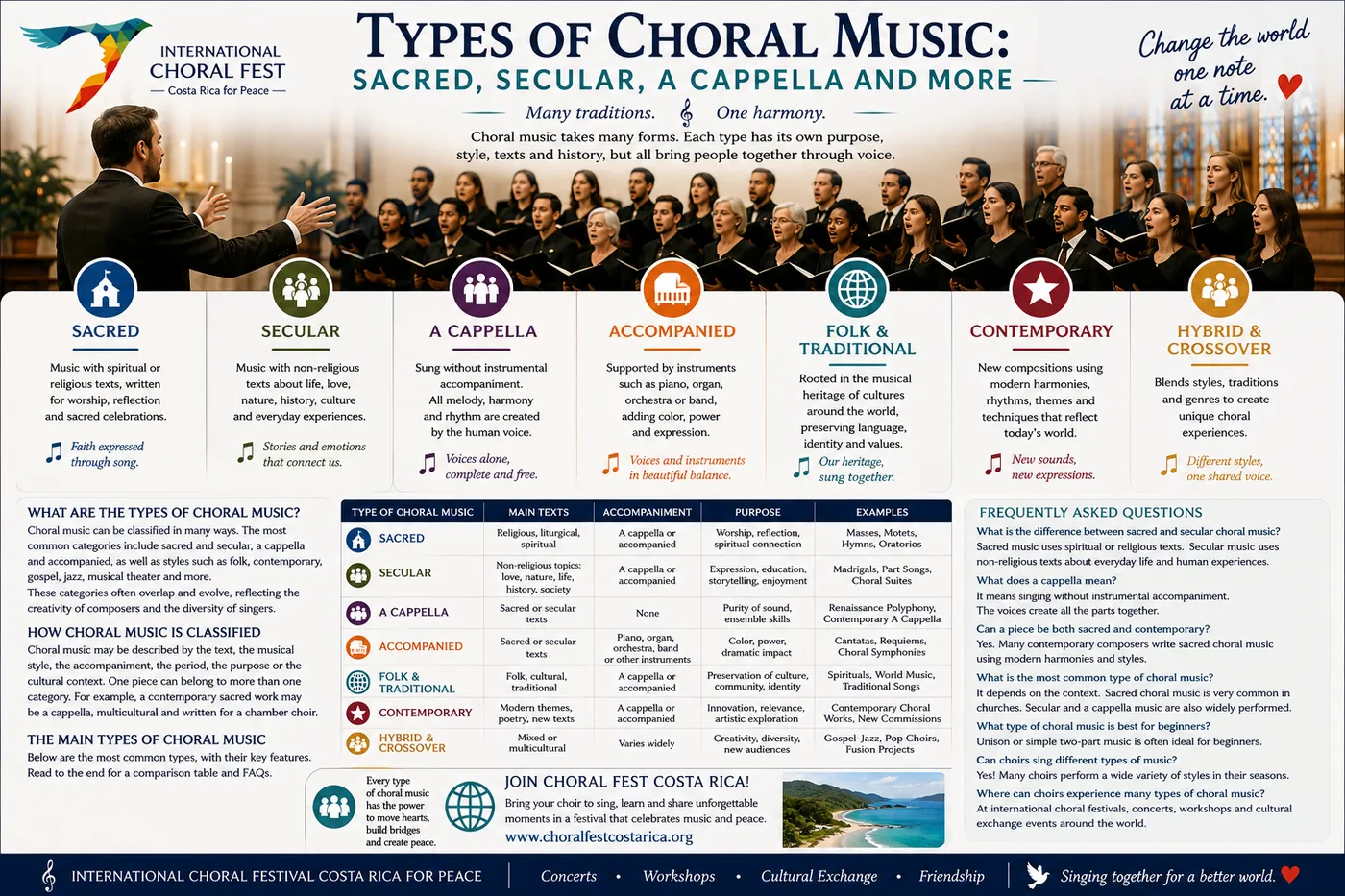
Types of choral music can be classified by text, purpose, musical style, accompaniment, historical period and cultural tradition. Sacred and secular music describe the subject of the text, while terms such as a cappella, accompanied, folk, gospel and contemporary describe how the music sounds or is performed.
These categories often overlap. A contemporary sacred work may be sung a cappella, while a traditional folk song may be arranged for choir and orchestra. This guide explains the main types of choral music and how each contributes to the diversity of the choral tradition.
Understanding the main types of choral music helps singers recognize style, directors choose repertoire more intelligently and audiences understand the cultural and historical context behind what they hear.
Types of Choral Music at a Glance
| Type | Main characteristics | Typical texts | Accompaniment |
|---|---|---|---|
| Sacred choral music | Connected to faith, worship or spiritual reflection | Religious, biblical or liturgical texts | A cappella or accompanied |
| Secular choral music | Explores human life, poetry, history and culture | Love, nature, humor, society and everyday experience | A cappella or accompanied |
| A cappella music | Performed without instruments | Sacred or secular | None |
| Accompanied choral music | Combines voices with instruments | Sacred or secular | Piano, organ, orchestra, band or other instruments |
| Folk and traditional music | Rooted in community heritage and cultural identity | Traditional stories, languages and customs | A cappella or accompanied |
| Gospel and spirituals | Expressive sacred traditions with strong cultural roots | Faith, freedom, hope and community | Voices, piano, organ, band or a cappella |
| Contemporary choral music | Uses modern harmonies, rhythms and vocal techniques | Religious, poetic, social or experimental texts | A cappella or accompanied |
| Crossover and popular choral music | Combines classical, popular and theatrical influences | Popular songs, film music and new arrangements | Varies widely |
How Is Choral Music Classified?
Choral music does not belong to only one classification system. A single composition may fit several categories at the same time.
Directors and singers may describe a work according to:
- Text: sacred, secular, poetic, dramatic or traditional.
- Accompaniment: a cappella or accompanied.
- Historical period: Medieval, Renaissance, Baroque, Classical, Romantic, modern or contemporary.
- Musical form: motet, madrigal, Mass, cantata, oratorio, anthem or part song.
- Cultural tradition: gospel, folk, spiritual, indigenous, regional or international.
- Performance setting: worship, concert, theater, school, community or festival.
- Vocal forces: unison, treble voices, lower voices, SATB, chamber choir or massed chorus.
Understanding these categories helps singers approach the text, style, pronunciation and musical purpose of each work more accurately.
This article is part of our broader Complete Guide to Choir Singing, where repertoire, vocal technique, SATB, rehearsals and performance preparation are connected in one central resource.
Sacred Choral Music
Sacred choral music uses religious, spiritual or liturgical texts. It has played a central role in the development of Western choral traditions and also appears in faith communities around the world.
Sacred music may be written for worship, ceremony, private devotion or public concert performance.
Common Forms of Sacred Choral Music
- Gregorian chant: monophonic sacred singing associated with the medieval church.
- Motet: a sacred polyphonic composition, especially important during the Renaissance.
- Mass: a setting of sections from the Christian liturgy.
- Anthem: a sacred choral work commonly used in English-speaking worship traditions.
- Cantata: a multi-movement vocal work that may be sacred or secular.
- Oratorio: a large-scale narrative work for choir, soloists and instruments.
- Passion: a musical setting of the story of the suffering and death of Jesus.
- Requiem: a work connected with remembrance, death and consolation.
Sacred music is not always solemn. It may express celebration, praise, lament, hope, mystery or profound spiritual reflection.
Secular Choral Music
Secular choral music uses nonreligious texts. Its subjects may include love, nature, history, work, humor, social life, politics and human emotion.
Secular vocal traditions have existed alongside sacred music for centuries. They allow composers to explore poetry, storytelling and everyday experience through ensemble singing.
Common Forms of Secular Choral Music
- Madrigal: a Renaissance vocal work that frequently sets poetry about love, nature or emotion.
- Part song: a short secular composition for several voice parts.
- Chanson: a French secular song tradition.
- Folk-song arrangement: a traditional melody adapted for choir.
- Choral theater: music combining voices with movement, drama or staging.
- Popular-song arrangement: a contemporary or historical popular song rewritten for an ensemble.
Sacred and secular traditions are compared in more detail in our guide to motet vs. madrigal.
A Cappella Choral Music
A cappella means singing without instrumental accompaniment. The choir creates the complete musical texture using only human voices.
A cappella music may be sacred or secular, ancient or contemporary. Renaissance motets, madrigals, spirituals, barbershop arrangements and modern vocal compositions can all be performed without instruments.
Skills Required for A Cappella Singing
- accurate intonation;
- independent voice parts;
- careful listening;
- consistent vowels;
- rhythmic precision;
- breath control;
- strong internal sense of pitch.
Without an instrument to reinforce harmony, singers must continuously adjust to the ensemble.
For a direct comparison, see A Cappella vs. Accompanied Choir.
Accompanied Choral Music
Accompanied choral music combines voices with one or more instruments. The accompaniment may support harmony, create rhythm, add color or participate as an equal musical partner.
Common combinations include:
- choir and piano;
- choir and organ;
- choir and chamber ensemble;
- choir and orchestra;
- choir and percussion;
- choir and jazz or popular band;
- choir and traditional instruments.
Large works such as cantatas, oratorios, Masses and choral symphonies often depend on close coordination between choir, soloists and instruments.
Our article on oratorio vs. cantata explains two important accompanied forms.
Folk and Traditional Choral Music
Folk and traditional choral music grows from the cultural heritage of communities. It may preserve language, stories, dance rhythms, religious practices and regional identity.
Traditional songs are often passed from one generation to another before being arranged for formal choir performance.
Approaching Traditional Repertoire Respectfully
Directors should research the origin, language and cultural meaning of each piece. Accurate pronunciation and proper credit are essential.
When possible, choirs should learn from culture bearers, native speakers, composers or musicians who understand the tradition directly.
Traditional music should not be reduced to decorative costumes or stereotypes. Its historical and social context forms part of the music itself.
Gospel Choral Music
Gospel music developed within African American religious traditions and remains an influential form of sacred choral expression.
It often features:
- call and response;
- strong rhythmic energy;
- expressive vocal color;
- improvisation;
- repetition;
- direct emotional communication;
- piano, organ, drums and other instruments.
Gospel music should be approached with an understanding of its spiritual, historical and cultural roots.
African American Spirituals
Spirituals emerged from the experiences of enslaved African Americans and express faith, suffering, resistance, hope and freedom.
They have become central to the international choral repertoire, but their cultural and historical meaning must not be separated from their musical beauty.
Directors should explain the origin of the texts and avoid performance choices that trivialize the experience from which the music emerged.
Classical Choral Music
Classical choral music includes works from the Medieval, Renaissance, Baroque, Classical, Romantic and modern concert traditions.
It may involve a cappella ensembles, chamber choirs, large choruses, soloists and orchestras.
Representative forms include:
- chant;
- motets;
- madrigals;
- Masses;
- cantatas;
- oratorios;
- Passions;
- Requiems;
- choral symphonies.
Readers can explore the development of these styles in our guides to the history of choral music and the evolution of choral music.
Contemporary Choral Music
Contemporary choral music refers to works created by living or recent composers. It may use traditional harmony or explore new sounds and performance techniques.
Contemporary works can include:
- extended vocal sounds;
- speech and whispering;
- unusual rhythms;
- cluster chords;
- electronic sound;
- body percussion;
- movement and staging;
- multimedia;
- music from different cultural traditions.
Modern composers frequently address identity, migration, climate, peace, memory, justice and community.
Popular and Crossover Choral Music
Crossover choral music combines traditions that are often treated separately. A choir may blend classical vocal technique with jazz, rock, pop, film music or musical theater.
Popular arrangements may include microphones, vocal percussion, choreography and instrumental bands.
The strongest arrangements respect the original song while using choral harmony and ensemble texture creatively.
Jazz Choirs
Jazz choral music uses swing, syncopation, extended harmony and improvisation. Singers may perform with a rhythm section or without instruments.
Jazz choirs need precise rhythmic coordination, stylistic articulation and flexibility in tone and phrasing.
Close harmony and complex chords make careful tuning especially important.
Barbershop Music
Barbershop music uses close four-part harmony, usually performed without instruments.
The traditional parts are:
- Lead: carries the melody.
- Tenor: sings above the melody.
- Baritone: completes the inner harmony.
- Bass: provides the lowest notes.
Accurate tuning creates strong overtones and the characteristic ringing sound of barbershop harmony.
Opera and Theater Choruses
Opera and musical-theater choruses combine ensemble singing with dramatic performance.
Singers may represent soldiers, citizens, workers, villagers or other groups within a story. They must coordinate voice, movement, acting, costumes and stage direction.
Musical-theater ensembles often perform popular or theatrical styles and may include choreography and amplified sound.
Choral Music for Children and Youth
Music for young choirs should support healthy vocal development, musicianship and emotional understanding.
Common repertoire includes:
- unison songs;
- canons;
- two- and three-part works;
- folk songs;
- school and community music;
- contemporary works for developing voices.
The range, text and difficulty should be appropriate for the singers’ age and stage of development.
Music for Community Choirs
Community choirs often perform a broad mixture of classical, sacred, folk, gospel, popular and contemporary repertoire.
Successful programming considers the abilities of the singers while still offering artistic challenge and variety.
Directors can connect these choices with How to Choose Music for Your Choir.
Accessible music does not have to be artistically simple. A well-selected program can welcome beginners and experienced singers while maintaining quality.
Music for Chamber and Professional Choirs
Chamber and professional choirs often perform repertoire requiring secure intonation, independence and advanced reading skills.
They may specialize in:
- Renaissance polyphony;
- contemporary a cappella music;
- early music;
- new commissions;
- complex choral-orchestral repertoire;
- recording and broadcast projects.
The smaller number of singers means that every individual voice is more exposed.
These ensembles often depend on secure choir blend and balance and accurate intonation.
How to Choose Choral Repertoire
Directors should consider more than personal preference when selecting music.
- Vocal range: Is the tessitura healthy for the ensemble?
- Difficulty: Can the singers learn the rhythm, harmony and language successfully?
- Text: Is the subject appropriate and meaningful?
- Cultural context: Can the choir perform the work respectfully?
- Accompaniment: Are the necessary instruments and musicians available?
- Program balance: Does the concert include variety in mood, tempo and style?
- Audience and occasion: Does the repertoire suit the event?
- Educational value: What will the singers learn?
How Different Types of Choral Music Work Together
A strong concert program can combine sacred and secular works, old and new music, local traditions and international repertoire.
For the next step, use Choir Repertoire Planning to organize contrast, duration and concert flow.
Contrast helps listeners understand the distinctive qualities of each style. A Renaissance motet may be followed by a contemporary work, while a traditional song may connect naturally with a modern arrangement.
The program should feel coherent rather than random. Directors can organize music around a theme, story, language, historical journey or shared human experience.
Frequently Asked Questions About Types of Choral Music
What are the main types of choral music?
Major categories include sacred, secular, a cappella, accompanied, folk and traditional, gospel, classical, contemporary and crossover choral music.
What is the difference between sacred and secular choral music?
Sacred music uses religious or spiritual texts, while secular music explores nonreligious subjects such as love, nature, history and everyday life.
What does a cappella mean?
A cappella means singing without instrumental accompaniment. All melody, harmony and rhythm are produced by the voices.
Can sacred music be contemporary?
Yes. Many living composers write sacred choral music using modern harmonies, rhythms and vocal techniques.
Can secular music be performed in a church?
Yes, depending on the event and policies of the venue. Performance location does not automatically determine whether the text is sacred or secular.
What type of choral music is best for beginners?
Unison songs, simple two-part works and music with comfortable ranges are often appropriate. The best choice depends on the age and experience of the singers.
Can one choral work belong to several categories?
Yes. A work may be contemporary, sacred and a cappella at the same time, or traditional, secular and accompanied.
What kinds of music can choirs perform at Choral Fest Costa Rica?
Participating choirs may share sacred, secular, classical, traditional, contemporary and other repertoire that represents their musical identity and follows the festival’s current participation guidelines.
What are the most common choral forms?
Common forms include the motet, madrigal, Mass, anthem, cantata, oratorio, Passion, Requiem, part song, spiritual, folk-song arrangement and contemporary concert work.
What is the difference between a choral style and a choral form?
A style describes musical language or tradition, such as gospel, Baroque or contemporary music. A form describes the structure or type of composition, such as a motet, cantata or oratorio.
What type of choral music is best for a community choir?
Community choirs often benefit from a varied program that combines accessible repertoire with one or two meaningful challenges. The best choices depend on available voice parts, rehearsal time and the experience of the singers.
What type of choral music is best for a chamber choir?
Chamber choirs often perform repertoire that rewards independence, detailed tuning and close ensemble listening, including Renaissance polyphony, contemporary a cappella music and advanced mixed-voice repertoire.
Can classical and popular choral music appear in the same concert?
Yes. A mixed program can work very well when the pieces are connected by theme, story, language, contrast or another clear artistic idea.
Why is cultural context important when choosing choral music?
Context helps singers understand language, performance practice, meaning and the community from which the music comes. It also reduces superficial or inaccurate performance choices.
How do directors decide which types of choral music belong in one program?
They consider the choir’s identity, vocal strengths, difficulty, text, cultural context, accompaniment, audience, concert purpose and rehearsal time.
Where should a director start when building a full concert program?
Begin with the choir you actually have, then choose repertoire that creates contrast without losing coherence. Our Choir Repertoire Planning guide provides a complete framework.
Conclusion
Exploring the different types of choral music gives singers and directors a clearer understanding of how history, culture, text, voicing and performance practice shape repertoire.
The many types of choral music reflect the extraordinary range of human expression. Sacred music offers prayer and reflection, secular music explores life and emotion, and traditional repertoire preserves cultural identity.
A cappella singing reveals the independence and precision of the human voice, while accompanied music combines singers with instrumental color and power. Contemporary and crossover styles continue to expand what a choir can sound like.
These categories are not rigid boundaries. They overlap, evolve and help singers discover how people from different times and cultures have used collective singing to express meaning.
Share Your Choral Tradition in Costa Rica
The International Choral Festival in Costa Rica for Peace welcomes choirs with different repertoires, languages, traditions and musical identities.
Whether your ensemble performs sacred music, folk songs, contemporary works, gospel, classical repertoire or music from your own community, the festival provides a non-competitive setting for concerts, learning and cultural exchange.
Apply with your choir → or explore the festival to learn more.