
Oratorio vs cantata: both are important vocal forms in classical music, but they differ in length, structure, themes, performance context and musical purpose.
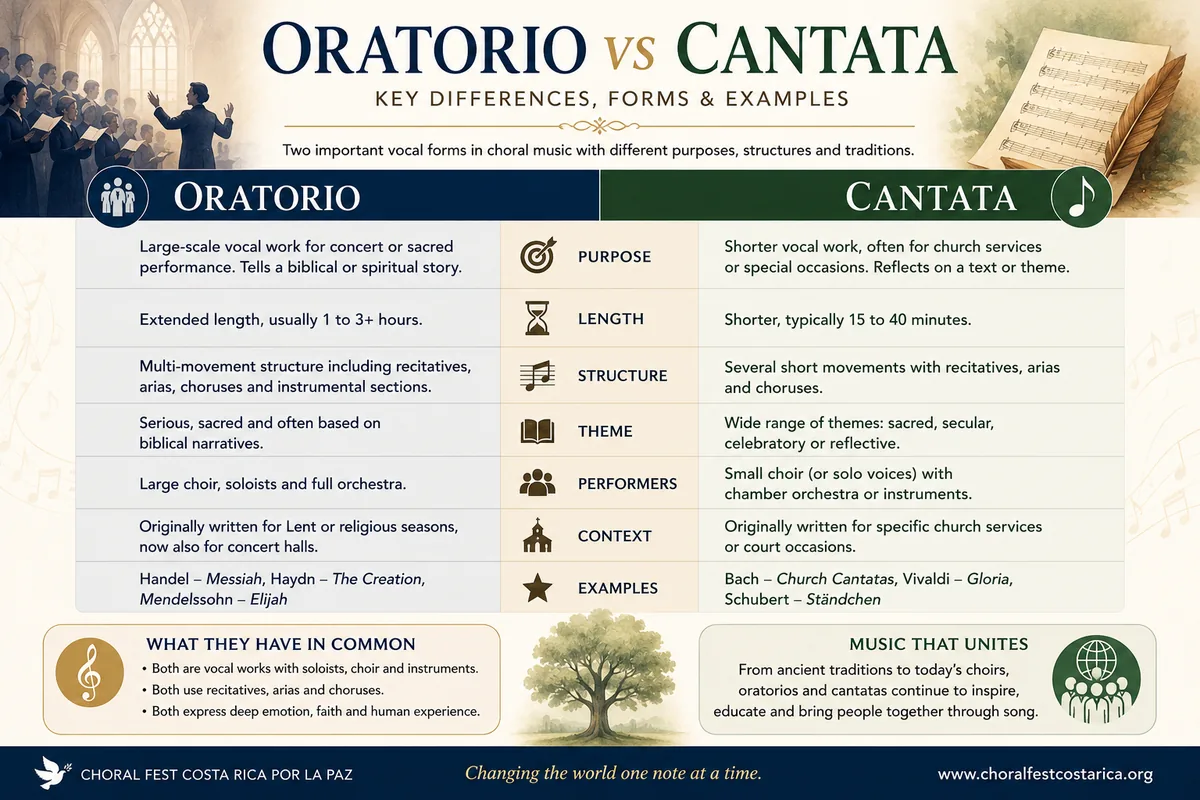
Oratorio vs Cantata: What Are the Main Differences? An oratorio is generally a larger…
Oratorio vs Cantata: What Are the Main Differences?
An oratorio is generally a larger, concert-length narrative work for soloists, choir and orchestra, while a cantata is usually shorter and may be written for worship, the concert stage or a specific occasion. Both can be sacred or secular. This guide compares their history, structure, performance context and best-known examples.
Understanding oratorio vs cantata is easier when we compare scale, dramatic purpose, musical forces, text and performance context side by side.
| Feature | Oratorio | Cantata |
|---|---|---|
| Length | Usually large-scale, often about 1–3 hours | Usually shorter, often about 15–40 minutes |
| Purpose | Extended dramatic or reflective concert work | Compact work for worship, concert or a specific occasion |
| Performance context | Usually performed in concert without staging | Church, concert, court, civic or private setting |
| Sacred or secular themes | Both; sacred subjects are historically prominent | Both sacred and secular |
| Structure | Multiple arias, recitatives and choruses within an extended design | Several concise movements, sometimes including chorales |
| Musical forces | Often full orchestra, choir and soloists | Usually smaller vocal and instrumental forces |
| Narrative role | Often tells or reflects on an extended story | Usually explores a theme, reading or occasion |
| Famous examples | Handel’s Messiah; Mendelssohn’s Elijah | Bach’s BWV 147, BWV 82 and Coffee Cantata |
What Is an Oratorio?
In the oratorio vs cantata comparison, the oratorio usually represents the larger and more extended dramatic form.
An oratorio is a large-scale narrative composition for soloists, choir and orchestra. Unlike opera, it is usually performed without costumes, scenery or acting. Many famous oratorios use biblical or sacred texts, but the genre also includes secular subjects.
For additional background, see Encyclopaedia Britannica’s overview of the oratorio.
History of Oratorios
The oratorio originated in the early 17th century in Italy, with roots in religious plays and liturgical dramas. The term “oratorio” itself is derived from the Italian word “oratorio,” meaning prayer hall, where these compositions were initially performed. Famous composers like George Frideric Handel and Johann Sebastian Bach played pivotal roles in popularizing the oratorio during the Baroque period.
For the larger historical context, see The History of Choral Music and The Evolution of Choral Music.
Structure of an Oratorio
Oratorios are typically divided into multiple movements, including overtures, arias, recitatives, and choruses. The narrative is usually conveyed through a combination of choral and solo passages, with the choir often representing the voice of the people or a group of characters.
What Is a Cantata?
In the oratorio vs cantata comparison, the cantata is usually shorter, more compact and more flexible in purpose.
A cantata is a vocal composition with instrumental accompaniment, written for solo voices, choir or both. Cantatas can be sacred or secular and are generally shorter than oratorios. They may be performed in worship, in concert or for a particular civic, courtly or private occasion.
For additional background, see Encyclopaedia Britannica’s overview of the cantata.
History of Cantatas
The cantata emerged in the early 17th century, around the same time as the oratorio. Initially, cantatas were secular and influenced by Italian opera. However, the sacred cantata soon became a significant part of Lutheran worship, especially in Germany. Johann Sebastian Bach is one of the most well-known composers of cantatas, having written over 200 for the Lutheran church.
To compare these forms with earlier Renaissance genres, see Motet vs. Madrigal.
Structure of a Cantata
Cantatas are generally composed of several concise movements, which may include arias, recitatives, choruses and chorales. Their texts may draw on a liturgical theme or biblical passage, but secular cantatas also use poetry, dramatic scenes and subjects from everyday life.
Key Differences Between Oratorios and Cantatas
The clearest way to understand oratorio vs cantata is to compare their scale, narrative function, musical forces and performance setting.
While oratorios and cantatas share some similarities, there are several key differences that set them apart:
1. Length and Complexity
Oratorios are generally longer and more complex than cantatas, often lasting one to three hours and developing an extended narrative. Cantatas are usually shorter, frequently between 15 and 40 minutes, although duration varies by work and period.
2. Performance Context
Oratorios are usually presented in concert without staging, costumes or acting. Cantatas may be performed within worship, in a concert or for a civic or private occasion, depending on the work.
3. Themes and Texts
Both oratorios and cantatas can be sacred or secular. Sacred subjects are especially prominent in the historical oratorio repertoire, while cantata texts range from liturgical readings and biblical passages to poetry, mythology and everyday subjects.
For a broader overview of repertoire categories, explore Types of Choral Music.
4. Musical Forces
Oratorios typically require larger musical forces, including a full orchestra, choir, and soloists. Cantatas, while also involving a choir and soloists, usually have more modest instrumental requirements.
For a broader comparison of vocal music with and without instruments, see A Cappella vs. Accompanied Choir.
Famous Examples of Oratorios and Cantatas
To better understand the differences between oratorios and cantatas, let’s look at some famous examples of each:
Notable Oratorios
- Messiah by George Frideric Handel: Perhaps the most famous oratorio of all time, Handel’s “Messiah” is a staple of the choral repertoire, especially around Christmas and Easter.
- St. Matthew Passion by Johann Sebastian Bach: This monumental Passion setting is closely related to the oratorio tradition and is often discussed alongside oratorios, but it is more precisely classified as a Passion.
- Elijah by Felix Mendelssohn: This dramatic oratorio tells the story of the prophet Elijah, blending lyrical arias with powerful choral movements.
Notable Cantatas
- Herz und Mund und Tat und Leben, BWV 147 by Johann Sebastian Bach: This well-known cantata includes the famous chorale “Jesu, Joy of Man’s Desiring.”
- Ich habe genug, BWV 82 by Johann Sebastian Bach: This introspective cantata is a favorite among soloists for its expressive arias and recitatives.
- Coffee Cantata, BWV 211 by Johann Sebastian Bach: One of Bach’s secular cantatas, this humorous work tells the story of a young woman’s love for coffee.
Actionable Tips for Appreciating Oratorios and Cantatas
1. Compare Scale and Structure
Listen for overall length, the balance between soloists and choir, and whether the music follows an extended narrative or a more compact sequence of movements.
2. Follow the Text
Use the libretto or sung text to hear how recitatives, arias, choruses and chorales carry the meaning.
3. Hear the Music Live
A live choir and instrumental ensemble make the contrast especially clear. The International Choral Festival in Costa Rica for Peace brings choirs together to share sacred and secular repertoire in a non-competitive setting.
4. Sing the Repertoire
Joining a choir that performs oratorios or cantatas offers a direct understanding of their vocal writing, text and ensemble demands.
Directors planning this repertoire can also use Choir Repertoire Planning and The Complete Guide to Choir Singing.
Conclusion
The oratorio vs cantata distinction is most useful when viewed through scale, narrative scope, musical forces and performance context rather than through one rigid rule.
Oratorios and cantatas share vocal and instrumental traditions, but they differ most clearly in scale, dramatic scope and performance context. Listening to Handel’s Messiah beside Bach’s Ich habe genug makes those contrasts easy to hear while revealing the expressive power both forms offer.
Frequently Asked Questions About Oratorios and Cantatas
Can an oratorio be staged?
Yes, although traditional oratorio performance is unstaged. Modern productions sometimes add movement, projections, lighting or theatrical elements, but the genre does not require staging in the way opera normally does.
Is a Passion the same as an oratorio?
No. A Passion is a specific large-scale vocal setting of the Passion narrative, especially associated with the final days of Jesus. It is closely related to oratorio in scale and musical forces but remains a distinct genre.
Why did Bach write so many cantatas?
Many of Bach’s sacred cantatas were written for the Lutheran church calendar, where new or adapted music was needed for Sundays and feast days throughout the year.
Can a community choir perform an oratorio?
Yes. Many community choirs perform oratorios successfully, especially when they have enough rehearsal time, suitable soloists, an orchestra or instrumental ensemble and a realistic understanding of the work’s vocal demands.
Which is easier for amateur choirs: a cantata or an oratorio?
A cantata is often more manageable because it is usually shorter and may use smaller musical forces. However, difficulty depends on the individual work, not only on the genre label.
Do cantatas always use a choir?
No. Some cantatas are written for solo voice and instruments, while others use choir, soloists or both.
Can oratorios be secular?
Yes. Although sacred subjects are historically prominent, secular oratorios also exist.
How should a choir choose between an oratorio and a cantata?
Directors should consider rehearsal time, available soloists, orchestra or instrumental resources, choir size, audience, venue, budget and the ensemble’s technical level.
What is the main difference between an oratorio and a cantata?
An oratorio is generally a larger narrative work for soloists, choir and orchestra, while a cantata is usually shorter and focuses on a theme, reading or occasion.
Is a cantata shorter than an oratorio?
Usually. Cantatas often last about 15 to 40 minutes, while many oratorios last roughly one to three hours, although individual works vary.
Are oratorios always religious?
No. Sacred subjects are historically prominent, but composers have also written secular oratorios.
Can a cantata be sacred or secular?
Yes. Cantatas may use liturgical or biblical texts, secular poetry, dramatic scenes or subjects from everyday life.
What is the difference between an opera, an oratorio and a cantata?
Opera is normally staged with acting, costumes and scenery. Oratorio is usually an extended, unstaged narrative concert work. Cantata is generally shorter and may be written for worship, concert or a specific occasion.
Is Handel’s Messiah an oratorio or a cantata?
Handel’s Messiah is an oratorio.
Is Bach’s St. Matthew Passion an oratorio?
It is more precisely classified as a Passion setting, although its scale and musical forces make it closely related to the oratorio tradition.
Do both oratorios and cantatas use a choir and soloists?
They can. Oratorios commonly combine choir, soloists and orchestra. Cantatas may use soloists, choir or both, usually with smaller instrumental forces.
Experience This Tradition Live at Choral Fest Costa Rica
If reading about oratorios and cantatas has you dreaming of experiencing them in person, the International Choral Festival in Costa Rica for Peace brings choirs from around the world together each year for exactly this kind of musical exchange — in a non-competitive setting focused on connection, culture and peace.
Apply with your choir → or explore the festival to learn more.