
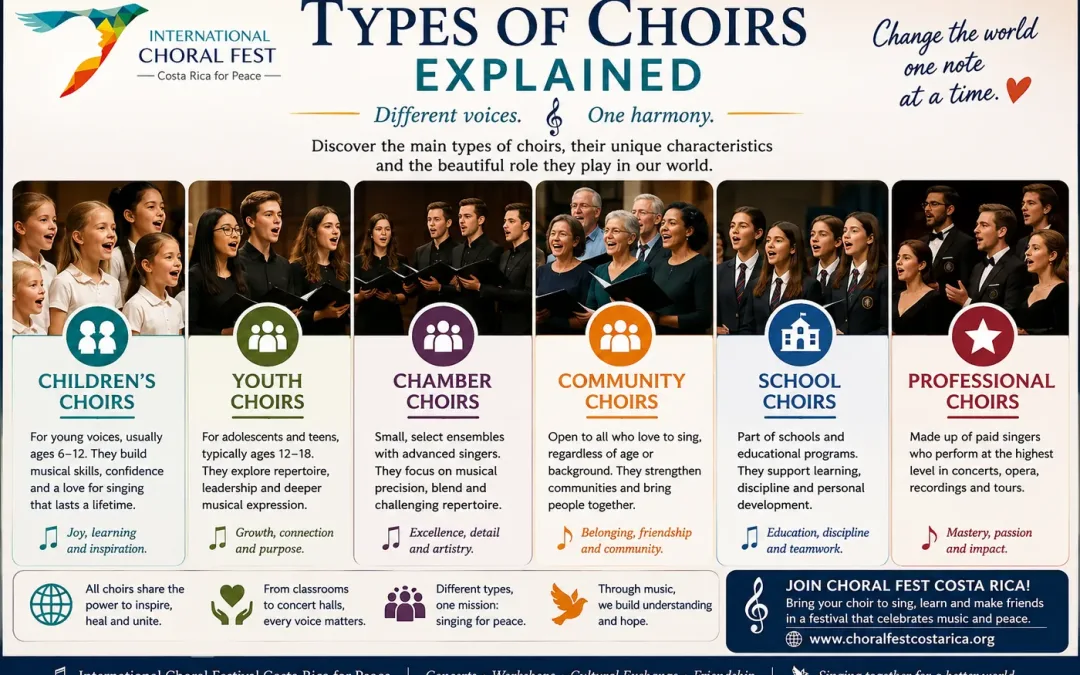
Types of choirs vary according to the age of their singers, vocal ranges, musical level, purpose, repertoire and performance setting. Some ensembles are created for children or students, while others bring together community members, trained chamber singers or professional musicians.
This guide explains the main types of choirs, how they are organized, what music they usually perform and how singers and directors can choose the ensemble that best matches their goals.
Understanding the different types of choirs helps singers choose the right ensemble and helps directors plan healthier, more realistic repertoire, rehearsals and performance goals.

Types of Choirs at a Glance
| Type of choir | Typical singers | Main purpose | Common repertoire |
|---|---|---|---|
| Children’s choir | Young treble voices | Musical education, confidence and vocal development | Unison songs, canons, folk music and age-appropriate choral works |
| Youth choir | Adolescents and young adults | Musical growth, leadership and ensemble experience | Treble, changing-voice and mixed-voice repertoire |
| School choir | Primary or secondary students | Education, teamwork and school participation | Educational, traditional, popular and concert music |
| University choir | College or university students | Advanced study, performance and campus community | Classical, contemporary, sacred and international repertoire |
| Community choir | Singers from a local area | Participation, belonging and public performance | Accessible classical, folk, gospel and popular music |
| Church choir | Members of a faith community | Support worship and sacred celebrations | Hymns, anthems, motets, gospel and liturgical music |
| Chamber choir | Smaller group of experienced singers | Precision, detailed interpretation and specialized repertoire | Renaissance polyphony, contemporary works and advanced a cappella music |
| Professional choir | Paid, highly trained singers | Concerts, recordings, broadcasts and specialized projects | Advanced repertoire from many periods and styles |
What Defines a Type of Choir?
The main types of choirs are usually defined by a combination of age, voice configuration, musical level, purpose, size and repertoire.
A choir is usually classified according to several characteristics rather than one fixed rule. These may include:
- Age: children, youth, university, adult or senior singers.
- Voice configuration: unison, treble voices, lower voices, SATB or another combination.
- Musical level: beginner, educational, advanced amateur or professional.
- Purpose: worship, education, community participation, competition, performance or cultural exchange.
- Size: small vocal ensemble, chamber choir, standard choir or massed chorus.
- Repertoire: sacred, classical, folk, gospel, jazz, popular, traditional or contemporary music.
- Institution: school, church, university, opera company, orchestra or independent organization.
One choir may belong to several categories at the same time. A university chamber choir, for example, is both an educational ensemble and a smaller advanced group.
Children’s Choirs
Among the most important types of choirs are ensembles designed specifically for children, adolescents and students.
A children’s choir brings together young singers, usually before or during the early stages of vocal change. These ensembles often focus on healthy singing, listening, pitch accuracy, rhythm, language and the joy of making music with others.
Children’s choirs may be connected to schools, churches, community organizations, music academies or independent programs.
Musical Goals of a Children’s Choir
- develop a natural and healthy singing voice;
- strengthen pitch matching and rhythmic awareness;
- introduce musical notation and ensemble skills;
- build confidence, responsibility and cooperation;
- explore songs from different languages and cultures.
Repertoire should match the age, vocal development and emotional understanding of the singers. Unison songs, simple two-part music, canons and carefully selected treble repertoire are common choices.
Directors can use how to choose music for your choir to evaluate range, tessitura, text and difficulty for each ensemble type.
Youth Choirs
Youth choirs normally serve adolescents or young adults. These ensembles may include treble voices, changing voices or a complete mixed-voice structure.
Because voices can change significantly during adolescence, directors should use flexible assignments and avoid forcing singers into ranges that are uncomfortable.
Our guide to SATB voice parts explains how soprano, alto, tenor and bass function in mixed choirs.
The Role of a Youth Choir
A youth choir can support musical development while also providing a strong sense of identity and belonging. Singers learn leadership, teamwork, discipline and cultural awareness through rehearsals, concerts and travel.
Youth ensembles often perform contemporary music, traditional songs, sacred repertoire, folk arrangements and works written specifically for developing voices.
School Choirs
A school choir is connected to a primary or secondary educational institution. It may rehearse during the school day, after classes or as part of a music curriculum.
The level and structure depend on the age of the students, available rehearsal time, school resources and the experience of the director.
Benefits of School Choir Participation
- musical literacy and vocal development;
- teamwork and responsibility;
- confidence in public performance;
- exposure to different languages and cultures;
- participation in school and community events.
Some schools maintain several ensembles, such as a beginning choir, concert choir, chamber choir or show choir.
University and College Choirs
University choirs bring together students from music programs and other academic disciplines. Some require auditions, while others are open to the entire campus community.
These ensembles may perform major choral-orchestral works, contemporary compositions, international repertoire, opera choruses and a cappella music.
University choirs frequently participate in tours, festivals, conferences and collaborations with orchestras or guest conductors.
Community Choirs
A community choir welcomes singers from a city, neighborhood or region. Many community ensembles are open to adults with different levels of experience, although some use auditions or section placement sessions.
The principal goal is often participation and connection rather than professional-level performance. However, many community choirs develop high artistic standards and present ambitious concerts.
Why Community Choirs Matter
Community choirs create regular opportunities for social connection, lifelong learning and shared cultural activity. They may also support local celebrations, charitable causes and collaborations with schools or other arts organizations.
Their repertoire can include classical works, folk songs, gospel, popular arrangements, world music and newly commissioned pieces.
For complete concert design, see choir repertoire planning.
Church and Sacred Choirs
A church choir supports worship, liturgical celebrations and the musical life of a faith community. Similar ensembles may also exist in synagogues, temples and other religious traditions.
Repertoire may include hymns, psalms, motets, anthems, spirituals, gospel music and larger sacred compositions.
The director must consider both musical quality and the role of the choir within the service. Clear diction, sensitivity to sacred texts and cooperation with religious leaders are especially important.
Chamber Choirs
A chamber choir is a smaller ensemble, often containing between approximately twelve and forty singers. The exact number varies according to the repertoire and organization.
Because each individual voice is more exposed, chamber choir singers usually need secure intonation, independent musicianship, flexibility and strong ensemble awareness.
These ensembles benefit especially from focused work on choir blend and balance and choir intonation.
Typical Chamber Choir Repertoire
- Renaissance motets and madrigals;
- Baroque and Classical chamber works;
- Romantic part songs;
- advanced contemporary compositions;
- a cappella music requiring detailed balance and tuning.
Readers can learn more about two important Renaissance forms in our guide to motet vs. madrigal.
Professional Choirs
A professional choir employs singers for rehearsals, performances, recordings or specific projects. Members are normally selected through competitive auditions and are expected to prepare music efficiently and accurately.
Professional ensembles may operate independently or work with orchestras, opera companies, broadcasters, churches and recording organizations.
Their repertoire can range from early music to contemporary premieres, film soundtracks, opera, sacred works and major choral-orchestral compositions.
Opera Choruses
An opera chorus forms part of a theatrical production. Its singers may represent citizens, soldiers, villagers, workers or other groups within the story.
Members must combine singing with acting, movement, costumes and stage direction. An opera chorus is commonly prepared by a chorus master before joining rehearsals with the principal conductor and stage director.
The relationship between choir and chorus terminology is explored in our article Choir vs. Chorus: What’s the Difference?
Show Choirs
A show choir combines choral singing with choreography, costumes and theatrical presentation. These groups are especially common in schools and universities in the United States.
Performers must coordinate vocal technique with movement, stage expression and visual presentation. Repertoire often includes popular music, musical theater and themed medleys.
Gospel Choirs
Gospel choirs perform music rooted in African American sacred traditions. Their performances often emphasize expressive singing, rhythmic energy, call and response, improvisation and strong communication with the audience or congregation.
Directors and singers should approach gospel repertoire with an understanding of its cultural, historical and spiritual context rather than treating it only as a vocal style.
Barbershop Choruses and Quartets
Barbershop singing uses close four-part harmony, usually without instrumental accompaniment. The traditional parts are tenor, lead, baritone and bass.
The lead normally carries the melody, while the other voices create characteristic chords and overtone-rich harmony.
Barbershop organizations may include quartets, larger choruses and ensembles of different gender configurations.
A Cappella Groups
An a cappella ensemble performs without instrumental accompaniment. It may be a traditional choir, chamber group, vocal band, university ensemble or professional group.
Some a cappella groups perform classical or sacred repertoire, while others use vocal percussion, microphones and arrangements of popular songs.
A cappella describes how the music is performed, not the age, size or institutional type of the choir.
Senior Choirs
Senior choirs create singing opportunities for older adults. Some are community ensembles, while others operate through retirement centers, health programs, churches or cultural organizations.
Directors may adapt rehearsal length, vocal warm-ups, printed materials and repertoire to support comfort and accessibility.
These ensembles can provide artistic fulfillment, social connection and continued musical learning throughout later life.
For broader information about healthy aging and social connection, see resources from the World Health Organization.
Festival and Massed Choirs
A festival choir is formed for a specific event, project or performance. Singers may come from several existing ensembles and rehearse together for a limited period.
A massed choir combines a large number of singers, sometimes hundreds or thousands, for a shared work or ceremonial occasion.
These projects require careful planning, clear rehearsal materials, strong coordination and conductors experienced in working with large musical forces.
For planning strategies, review how to organize an effective choir rehearsal and how to conduct a choir.
Virtual Choirs
A virtual choir combines recordings made separately by singers in different locations. Audio and video editors synchronize the individual contributions into one digital performance.
Virtual projects expanded access to international collaboration, especially when singers could not meet physically. However, they do not reproduce the real-time listening and shared acoustical experience of singing in the same room.
Choir Types by Vocal Configuration
Another practical way to classify types of choirs is by the voice parts used in the ensemble.
Choirs may also be classified according to their voice parts:
- Unison choir: all singers perform the same melodic line.
- Treble choir: higher voices, often children or adult soprano and alto singers.
- Lower-voice choir: tenor, baritone and bass voices.
- Mixed choir: higher and lower voices, commonly organized as SATB.
- SSA or SSAA choir: three or four treble parts.
- TTBB choir: two tenor and two bass parts.
- SAB choir: soprano, alto and baritone, often used when tenor numbers are limited.
Our guide to SATB voice parts explains soprano, alto, tenor and bass in greater detail.
How to Choose the Right Choir
Choosing among different types of choirs should begin with vocal comfort, musical goals, rehearsal expectations and the culture of the ensemble.
Singers looking for an ensemble should consider:
- age and vocal development;
- comfortable range and voice part;
- musical reading ability;
- preferred repertoire;
- audition requirements;
- rehearsal schedule and location;
- performance and travel expectations;
- competitive or non-competitive environment;
- costs, uniforms and membership commitments;
- the social and artistic culture of the group.
The best choir is not necessarily the most advanced. It is the ensemble in which a singer can develop healthily, contribute meaningfully and feel respected.
Singers preparing to join a new ensemble may also benefit from guidance on choir auditions.
How Directors Choose the Right Choir Structure
Directors creating a new ensemble should begin with the people and purpose rather than selecting a name first.
Consider the available singers, their ranges, musical experience, rehearsal time, institutional support and the needs of the community.
A small but balanced chamber choir may be more successful than a large ensemble with unsuitable repertoire. A unison children’s choir may provide stronger musical development than forcing young singers into complex harmony too early.
Frequently Asked Questions About Types of Choirs
What are the main types of choirs?
Common types include children’s, youth, school, university, community, church, chamber, professional, gospel, show, opera, senior and virtual choirs.
What is the difference between a chamber choir and a community choir?
A chamber choir is normally smaller and may require advanced musicianship or auditions. A community choir is usually organized around local participation and may welcome singers with a wider range of experience.
What type of choir is best for beginners?
A community choir, school choir, church choir or open-access ensemble may be appropriate. The best choice offers supportive instruction, suitable repertoire and healthy vocal expectations.
What is a mixed choir?
A mixed choir includes higher and lower voices, most commonly organized into soprano, alto, tenor and bass sections.
What is a treble choir?
A treble choir uses higher vocal parts and may include children, adolescents or adult soprano and alto singers.
Does a professional choir always perform classical music?
No. Professional choirs may perform classical, sacred, contemporary, opera, film, popular, experimental and culturally specific repertoire.
Can one choir belong to more than one category?
Yes. An ensemble might be a university chamber choir, a professional church choir or a children’s community choir.
What types of choirs can attend Choral Fest Costa Rica?
Children’s, youth, school, university, church, community, chamber, adult and other vocal ensembles may participate, subject to the festival’s current conditions and program.
What is the best type of choir for a complete beginner?
A school choir, community choir, church choir or other open-access ensemble is often a good starting point because these groups may offer supportive instruction and repertoire suited to developing singers.
What is the difference between a chamber choir and a concert choir?
A chamber choir is usually smaller and places greater responsibility on each individual singer. A concert choir is often larger and may perform a broader range of repertoire with more singers on each part.
What is the difference between a school choir and a youth choir?
A school choir is connected to an educational institution, while a youth choir may operate independently, through a community organization, church, conservatory or cultural program.
What type of choir is best for children?
A children’s choir with age-appropriate repertoire, healthy vocal expectations, clear rehearsal structure and a director experienced with young voices is usually the best choice.
What type of choir is best for adults who cannot read music?
Many community, church and open-access choirs welcome singers who are still developing music-reading skills. Ask about audition requirements and whether rehearsal tracks or sectional support are provided.
What is the difference between a choir and an a cappella group?
A choir is an ensemble category, while a cappella describes singing without instrumental accompaniment. A choir can sing a cappella, and an a cappella group can be a choir, chamber ensemble or vocal band.
What is a festival choir?
A festival choir is formed for a specific event or project and may combine singers from several existing ensembles for shared repertoire, workshops or a final performance.
Can a choir belong to more than one category?
Yes. An ensemble may be a university chamber choir, a professional church choir, a youth community choir or another combination depending on age, purpose, institution and level.
How should directors choose the right structure for a new choir?
Begin with the singers who are actually available, their ranges, ages, experience, rehearsal time and the purpose of the ensemble. Then choose voicing and repertoire that fit those realities.
What types of choirs are suitable for international festivals?
Children’s, youth, school, university, community, church, chamber, adult and other vocal ensembles can participate in many international festivals when they meet the event’s current requirements.
Conclusion
Understanding the different types of choirs makes it easier to choose repertoire, organize rehearsals and create an ensemble in which singers can develop successfully.
Choirs differ in age, size, voice configuration, repertoire, purpose and level of training. A children’s choir builds early musical foundations, a community choir creates belonging, a chamber choir emphasizes precision and a professional choir meets specialized artistic demands.
Despite these differences, every choir depends on the same essential principles: listening, cooperation, healthy vocal production and respect for the contribution of every singer.
The variety of choir types demonstrates how collective singing can belong to people at every age and level of experience.
Bring Your Choir to Costa Rica
The International Choral Festival in Costa Rica for Peace welcomes ensembles with different ages, traditions, vocal configurations and musical identities.
Children’s choirs, youth ensembles, school and university choirs, church groups, community choirs and advanced vocal ensembles can share their repertoire in a non-competitive setting centered on concerts, learning, culture and friendship.
Apply with your choir → or explore the festival to learn more.