
Learning how to conduct a choir involves much more than moving the hands in time. A choir conductor must prepare the score, communicate pulse and phrasing, teach healthy vocal technique, diagnose musical problems and create an environment where singers can listen, learn and perform confidently.
This practical guide explains the foundations of choral conducting for new directors, including posture, beat patterns, preparatory gestures, entrances, cutoffs, dynamics, rehearsal planning, score study and communication with singers and accompanists.
Understanding how to conduct a choir becomes easier when gesture, score study, rehearsal planning and human leadership are developed together.
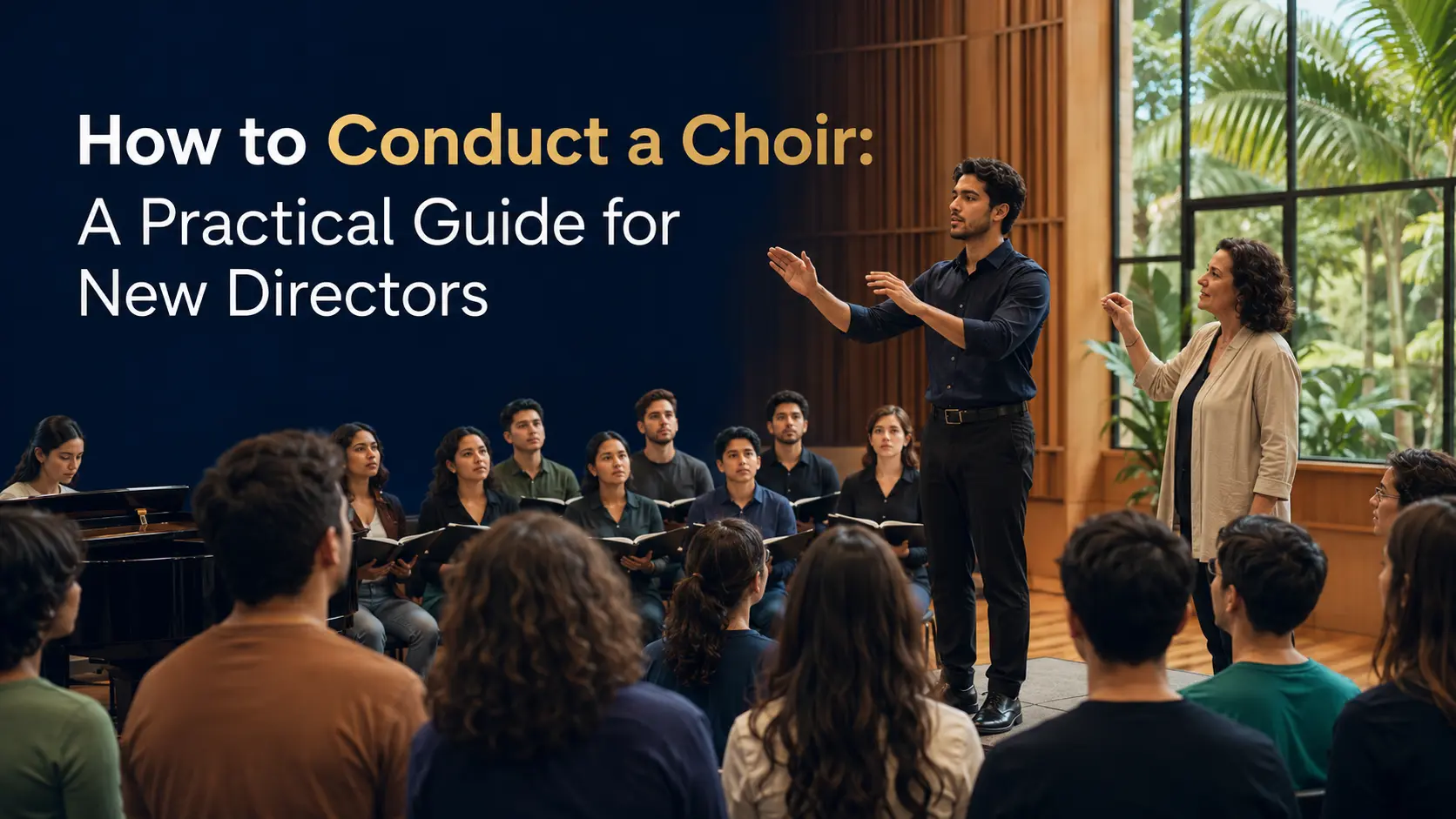
How to Conduct a Choir at a Glance
| Conducting skill | Main purpose | What singers need to see |
|---|---|---|
| Posture | Create clarity and physical freedom | A balanced, confident and relaxed leader |
| Beat pattern | Show meter and pulse | Clear beat locations and consistent movement |
| Preparatory gesture | Communicate the breath and first entrance | Tempo, dynamic, character and timing |
| Entrance cue | Tell a section when to begin | Eye contact and a clear directional gesture |
| Cutoff | Coordinate the end of sound | Exact timing and shape of the release |
| Dynamics | Shape musical intensity | Changes in gesture size, energy and direction |
| Phrasing | Communicate musical direction | Where the line grows, breathes and resolves |
| Rehearsal communication | Solve problems efficiently | Brief, specific and actionable instructions |
What Does a Choir Conductor Do?
A choir conductor is responsible for the musical preparation and direction of an ensemble.
The role may include:
- selecting repertoire;
- studying scores;
- planning rehearsals;
- teaching notes and rhythm;
- developing vocal technique;
- shaping phrasing and interpretation;
- coordinating accompanists and instrumentalists;
- preparing concerts;
- supporting ensemble communication;
- maintaining a respectful rehearsal culture.
The conductor does not produce the sound directly. The choir creates the sound, while the conductor helps singers coordinate their individual contributions into one musical result.
Begin With Balanced Conducting Posture
Good posture is the physical foundation of how to conduct a choir with clarity and freedom.
Conducting should begin from a position that is stable, visible and free from unnecessary tension.
A balanced posture includes:
- feet comfortably apart;
- knees released;
- spine lengthened;
- shoulders relaxed;
- head balanced naturally;
- arms free to move;
- hands visible to the entire choir.
A rigid body can produce rigid gestures. Excessive movement can also distract singers and make the beat difficult to follow.
Common Conducting Posture Problems
- locked knees;
- raised shoulders;
- leaning forward continuously;
- conducting too low for singers to see;
- moving the entire body for every beat;
- tight wrists and fingers;
- standing too close to the first row.
Establish a Clear Conducting Plane
The conducting plane is the imaginary area where the main beats are shown.
For most choral conducting, the beat pattern should remain visible around the center of the torso, approximately between the waist and upper chest.
The exact height may change according to:
- ensemble size;
- stage arrangement;
- musical character;
- dynamic level;
- visibility.
Very low gestures may disappear behind music folders. Very high gestures may create shoulder tension and reduce precision.
Understand the Baton and the Hands
Many choir conductors work without a baton because the hands can communicate breath, text, phrasing and tone directly.
A baton may still be useful for:
- large choral-orchestral works;
- clear rhythmic precision;
- conducting from a distance;
- complex instrumental coordination.
Whether using a baton or not, the conductor should avoid meaningless finger movement and unclear hand shapes.
New directors may also benefit from reviewing common choir terms before leading rehearsals.
Right and Left Hand Functions
Traditionally, the right hand often shows the principal beat pattern while the left hand communicates:
- entrances;
- dynamics;
- phrasing;
- balance;
- cutoffs;
- expressive character.
These functions are flexible. Both hands should serve the music rather than follow a rigid rule.
Learn the Basic Beat Patterns
Reliable beat patterns are essential when learning how to conduct a choir for the first time.
Two-Beat Pattern
A basic two-beat pattern moves:
- down for beat one;
- up for beat two.
This pattern is commonly used in 2/4, 2/2 and some fast compound meters.
Three-Beat Pattern
A basic three-beat pattern moves:
- down for beat one;
- outward for beat two;
- up for beat three.
This is commonly used in 3/4 and related triple meters.
Four-Beat Pattern
A basic four-beat pattern moves:
- down for beat one;
- inward for beat two;
- outward for beat three;
- up for beat four.
This is commonly used in 4/4 and other quadruple meters.
Six-Beat Pattern
Slow 6/8 may be conducted in six, while faster 6/8 is often conducted in two larger beats.
The conductor should choose the pattern that communicates pulse and subdivision most clearly.
For additional help with notation and meter, see how to read choral music.
Make Every Beat Location Clear
The exact point where the beat occurs is sometimes called the ictus.
Singers should be able to recognize:
- where each beat lands;
- how fast the next beat will arrive;
- whether the gesture is legato or detached;
- how much energy the music requires.
Large circles and vague movements can hide the beat. The gesture should be clear without becoming mechanical.
Conduct the Character, Not Only the Meter
The same four-beat pattern can communicate very different musical characters.
A gesture may be:
- smooth and connected;
- light and detached;
- heavy and dramatic;
- gentle and suspended;
- rhythmic and energetic.
The shape, speed, weight and direction of the gesture should reflect the sound the conductor wants to hear.
Give a Clear Preparatory Gesture
A clear preparation is one of the most practical answers to how to conduct a choir so singers breathe and enter together.
The preparatory gesture is one of the most important actions in conducting.
Before the choir begins, it should communicate:
- tempo;
- meter;
- dynamic level;
- character;
- breath timing;
- the exact entrance.
How to Give a Preparatory Gesture
- Establish eye contact.
- Prepare the hands in a visible position.
- Show the beat before the entrance.
- Shape the gesture according to the music.
- Allow the choir to breathe with the gesture.
- Move clearly into the first sung beat.
A conductor should not inhale after giving the preparation. The conductor and choir should breathe together.
Cue Choir Entrances
A cue tells a singer or section when to begin.
An effective cue combines:
- eye contact;
- breath;
- a directional gesture;
- clear timing;
- appropriate facial expression.
Prepare Before the Entrance
Look at the section early enough for singers to prepare. Turning toward them at the exact moment of entry may be too late.
A useful sequence is:
- look toward the section;
- prepare the breath;
- give the entrance gesture;
- continue conducting the phrase.
Conduct Cutoffs Clearly
A cutoff must communicate when the sound ends and how it ends.
The release may be:
- clean and immediate;
- soft and gradual;
- followed by a consonant;
- connected to the next breath;
- held under a fermata.
Basic Cutoff Process
- Prepare the choir visually.
- Show the final duration clearly.
- Move toward a release point.
- Close or redirect the gesture.
- Maintain eye contact through the silence.
Do not drop the hands before the sound has finished.
Coordinate Final Consonants
A choral cutoff may include a final consonant after the vowel ends.
The conductor should decide:
- whether the consonant occurs on the beat;
- whether it occurs immediately after the beat;
- how long the vowel continues;
- whether the next phrase begins immediately.
Rehearse the vowel release and consonant placement separately when necessary.
Conduct Dynamics
Dynamic gestures should reflect intensity without becoming exaggerated.
General principles include:
- larger gestures may suggest greater intensity;
- smaller gestures may suggest softer singing;
- upward movement can suggest growth;
- lower, calmer gestures can suggest reduction;
- open hands may invite expansion;
- focused gestures may request clarity or restraint.
Gesture size alone is not enough. Facial expression, posture and energy also influence the choir.
Conduct Crescendo and Diminuendo
Crescendo
To show a crescendo:
- increase gesture size gradually;
- create forward musical direction;
- avoid sudden unnecessary acceleration;
- indicate which voice part should lead.
Diminuendo
To show a diminuendo:
- reduce gesture size gradually;
- maintain energy and breath support;
- avoid collapsing posture;
- keep the pulse clear.
Conduct Phrasing
Phrasing communicates how musical ideas begin, grow, arrive and release.
A conductor should understand:
- where the phrase begins;
- where the important text lies;
- where the harmony intensifies;
- where the climax occurs;
- where the phrase resolves;
- where singers should breathe.
The gesture should move through the phrase rather than treating every beat as equally important.
Use Facial Expression
The conductor’s face can communicate:
- character;
- text meaning;
- energy;
- softness;
- surprise;
- calm;
- dramatic tension.
Facial expression should support the music naturally. Exaggerated expressions can become distracting or unclear.
Maintain Eye Contact
A conductor who looks only at the score cannot communicate fully with the choir.
Eye contact is especially important:
- before entrances;
- during tempo changes;
- at cutoffs;
- during fermatas;
- when a section needs support;
- at important textual moments.
Score preparation allows the conductor to look up more frequently.
Study the Score Before Rehearsal
Score study is central to how to conduct a choir efficiently because every gesture should come from musical understanding.
Conducting begins with score study.
The Library of Congress Moldenhauer Archives offers examples of historical musical manuscripts that can support deeper score-study awareness.
Before rehearsal, identify:
- form;
- key changes;
- meter changes;
- tempo relationships;
- voice ranges;
- difficult rhythms;
- important entrances;
- harmonic tension;
- text meaning;
- breathing points;
- instrumental cues;
- rehearsal priorities.
Mark the Score Carefully
Useful markings may include:
- entrance cues;
- cutoffs;
- tempo changes;
- subdivision;
- translations;
- pronunciation;
- section balance;
- difficult intervals;
- rehearsal numbers.
Do not cover the score with markings that make it harder to read.
Understand the Text
A conductor should know what every word means.
Text preparation includes:
- translation;
- pronunciation;
- word stress;
- emotional context;
- historical background;
- relationship between text and music.
The conductor cannot shape meaningful phrasing without understanding the text.
Plan the Rehearsal
A conducting gesture cannot replace an effective rehearsal plan.
Prepare:
- two or three main objectives;
- the order of repertoire;
- specific difficult passages;
- warm-ups related to the music;
- sectional assignments;
- time limits;
- the final run-through.
Our guide to an effective choir rehearsal provides sample schedules and rehearsal strategies.
Diagnose Before Correcting
When the choir makes a mistake, determine the actual cause.
The problem may involve:
- incorrect notes;
- unclear rhythm;
- poor breath planning;
- unified vowels;
- section imbalance;
- unclear conducting;
- uncomfortable tessitura;
- lack of harmonic understanding.
Repeating the passage without diagnosis usually wastes time.
When tuning is the main problem, use the practical exercises in how to improve choir intonation.
Use Clear Rehearsal Language
Instructions should be brief, specific and actionable.
Instead of saying:
That was not expressive enough.
Say:
Begin more softly, grow through measure 18 and release the final consonant with my left hand.
Instead of saying:
Tenors, you are wrong.
Say:
Tenors, the second note is F-sharp. Sing measures 22–24 slowly with the piano, then repeat without it.
Conduct Less When the Choir Needs to Listen More
More movement does not always create better singing.
Reduce gesture when the choir needs to develop:
- internal pulse;
- independence;
- chamber-music awareness;
- conductor-free coordination;
- careful listening.
A conductor should provide enough information without controlling every sound physically.
Developing choir blend and balance also requires singers to listen and adjust independently.
Conduct A Cappella Music
A cappella conducting requires attention to:
- pitch stability;
- tempo consistency;
- vowel matching;
- breathing;
- harmonic balance;
- quiet reentries after staggered breaths.
The conductor should avoid becoming dependent on piano corrections throughout rehearsal.
Read our comparison of a cappella vs. accompanied choir.
Conduct With Piano
When working with a pianist:
- share the rehearsal plan;
- agree on tempo and cuts;
- indicate when parts should be doubled;
- reduce piano support as singers improve;
- maintain visual communication;
- treat the pianist as a musical collaborator.
The conductor should not speak continuously while the pianist waits without clear instructions.
Conduct Choir and Orchestra
Choral-orchestral conducting requires coordination among:
- choir;
- soloists;
- orchestra;
- continuo or keyboard;
- stage and venue personnel.
The conductor must understand instrumental cues, balance and rehearsal priorities.
Choirs should not be asked to overcome excessive orchestral volume through vocal force.
Conduct Changing Meters
When meter changes:
- prepare the new pattern early;
- show subdivision clearly;
- maintain the relationship between tempos;
- avoid unnecessary large gestures;
- rehearse the transition separately.
Mark every meter change in the score.
Conduct Fermatas
A fermata requires control of:
- the arrival;
- the duration;
- the release;
- the breath after the release;
- the next entrance.
Maintain eye contact and avoid unclear circular motion.
Conduct Tempo Changes
Ritardando
Show gradual slowing through increasingly spaced gestures while maintaining musical direction.
Accelerando
Reduce the time between beats gradually without creating sudden panic.
A Tempo
Prepare the return clearly so the choir knows exactly when the original tempo resumes.
Conduct Divided Voice Parts
Divisi passages may require separate cues for:
- soprano 1 and soprano 2;
- alto 1 and alto 2;
- tenor 1 and tenor 2;
- bass 1 and bass 2.
Directors should know which subsection carries the principal line and avoid giving identical visual priority to every part.
Conduct Children’s Choirs
Children need gestures that are:
- clear;
- visible;
- energetic;
- consistent;
- connected to imagination and text.
Rehearsal language should be concise, concrete and age-appropriate.
Age-appropriate vocal warm-ups for choirs can help children connect gesture, breath and sound.
Do not expect young singers to watch continuously during long verbal explanations.
Conduct Youth Choirs
Youth conductors should consider:
- changing voices;
- confidence;
- range flexibility;
- social dynamics;
- clear routines;
- respectful correction.
Avoid public comments that embarrass singers about their developing voices.
Conduct Community Choirs
Community choirs may include singers with different levels of musical experience.
Effective directors:
- explain notation clearly;
- provide practice resources;
- maintain high but realistic standards;
- avoid unnecessary technical jargon;
- create a welcoming rehearsal culture.
Conduct Chamber and Advanced Choirs
Advanced ensembles may need:
- smaller gestures;
- greater singer independence;
- subtle dynamic communication;
- complex meter preparation;
- historical style awareness;
- advanced intonation work;
- conductor-free passages.
Advanced singers still require clear preparation and musical purpose.
Develop Rehearsal Authority Without Fear
Healthy leadership is part of how to conduct a choir with consistency, respect and trust.
Authority comes from preparation, clarity, consistency and trust.
It does not require:
- shouting;
- sarcasm;
- humiliation;
- unpredictable anger;
- constant criticism;
- creating fear around mistakes.
A demanding rehearsal can remain respectful and supportive.
For general voice-care guidance, directors can consult the National Institute on Deafness and Other Communication Disorders.
Invite Questions Without Losing Focus
Singers should be able to ask relevant questions, especially about:
- notes;
- rhythm;
- pronunciation;
- breathing;
- concert logistics;
- vocal comfort.
The conductor may redirect questions that are better handled after rehearsal or through administrative communication.
Use Recordings to Evaluate Conducting
Record rehearsals or practice sessions and observe:
- whether beat patterns are clear;
- how often the eyes remain in the score;
- whether cues arrive early enough;
- how much unnecessary movement occurs;
- whether gestures match the desired sound;
- how much rehearsal time is spent talking.
Video often reveals habits that the conductor does not notice while working.
Practice Conducting Without a Choir
Useful independent practice includes:
- conducting in front of a mirror;
- recording beat patterns;
- conducting along with a score and recording;
- practicing entrances and cutoffs;
- conducting with the non-dominant hand;
- singing one part while conducting another cue;
- practicing tempo transitions.
Common Choir Conducting Mistakes
- Unclear beat patterns: singers cannot identify the pulse.
- No preparatory gesture: the choir enters without shared breath or tempo.
- Late cues: sections see the entrance only after it has begun.
- Conducting too much: unnecessary movement hides important information.
- Looking only at the score: communication with singers disappears.
- Talking too long: rehearsal energy declines.
- Repeating without diagnosis: mistakes continue.
- Using identical gestures for every style: the choir receives no musical character.
- Ignoring vocal health: singers are pushed beyond comfortable limits.
- Using fear as authority: trust and musical risk-taking disappear.
A 15-Minute Daily Conducting Practice Routine
| Time | Practice activity |
|---|---|
| 0:00–0:03 | Posture and relaxed arm movement |
| 0:03–0:06 | Two-, three- and four-beat patterns |
| 0:06–0:09 | Preparatory gestures, entrances and cutoffs |
| 0:09–0:12 | Dynamics and phrase shaping |
| 0:12–0:15 | Conduct one score excerpt while singing a vocal line |
How to Know Your Conducting Is Improving
Conducting is improving when:
- the choir enters together;
- cutoffs become cleaner;
- singers look up more often;
- tempo remains stable;
- fewer verbal instructions are needed;
- gestures become smaller and clearer;
- sections understand their musical priority;
- the sound changes in response to the gesture;
- rehearsals become more efficient.
Frequently Asked Questions About Conducting a Choir
Do choir conductors need a baton?
No. Many choral conductors use their hands because they can communicate breathing, text and phrasing directly. A baton may help in large choral-orchestral works.
Which hand keeps the beat?
The right hand commonly shows the main beat pattern, but either hand may be used according to the conductor’s technique and musical purpose.
How do conductors cue an entrance?
They establish eye contact, show a preparatory breath and give a clear directional gesture at the correct time.
How do conductors show a cutoff?
They prepare the release visually and move toward a clear closing point while maintaining eye contact.
Should a conductor memorize the score?
Complete memorization is not always necessary, but the conductor should know the music well enough to look at the choir during important moments.
How can a new conductor improve quickly?
Practice basic patterns daily, study scores, record rehearsals, seek feedback and work with ensembles regularly.
How much should a conductor talk during rehearsal?
Only enough to help the next attempt improve. Instructions should be brief, specific and actionable.
What is the most important quality of a choir conductor?
Preparation is foundational. Clear technique, listening, communication and respect all depend on knowing the music and the ensemble.
Conclusion
Learning how to conduct a choir is a continuing process of observation, preparation, practice and respectful musical leadership.
Conducting a choir combines physical gesture, musical understanding, vocal knowledge and human leadership.
New conductors should begin with clear posture, reliable beat patterns, effective preparatory gestures and careful score study. As technique develops, gestures should communicate not only tempo but also breath, text, phrasing and ensemble balance.
The conductor’s goal is not to display movement. It is to help singers create music together with clarity, confidence and shared purpose.
Develop Your Choir Through International Exchange
The International Choral Festival in Costa Rica for Peace welcomes conductors and choirs for concerts, workshops and cultural exchange in a non-competitive environment.
Directors can share repertoire, meet colleagues from other traditions and create meaningful connections through choral music.
Apply with your choir → or explore Choral Fest Costa Rica to learn more.