
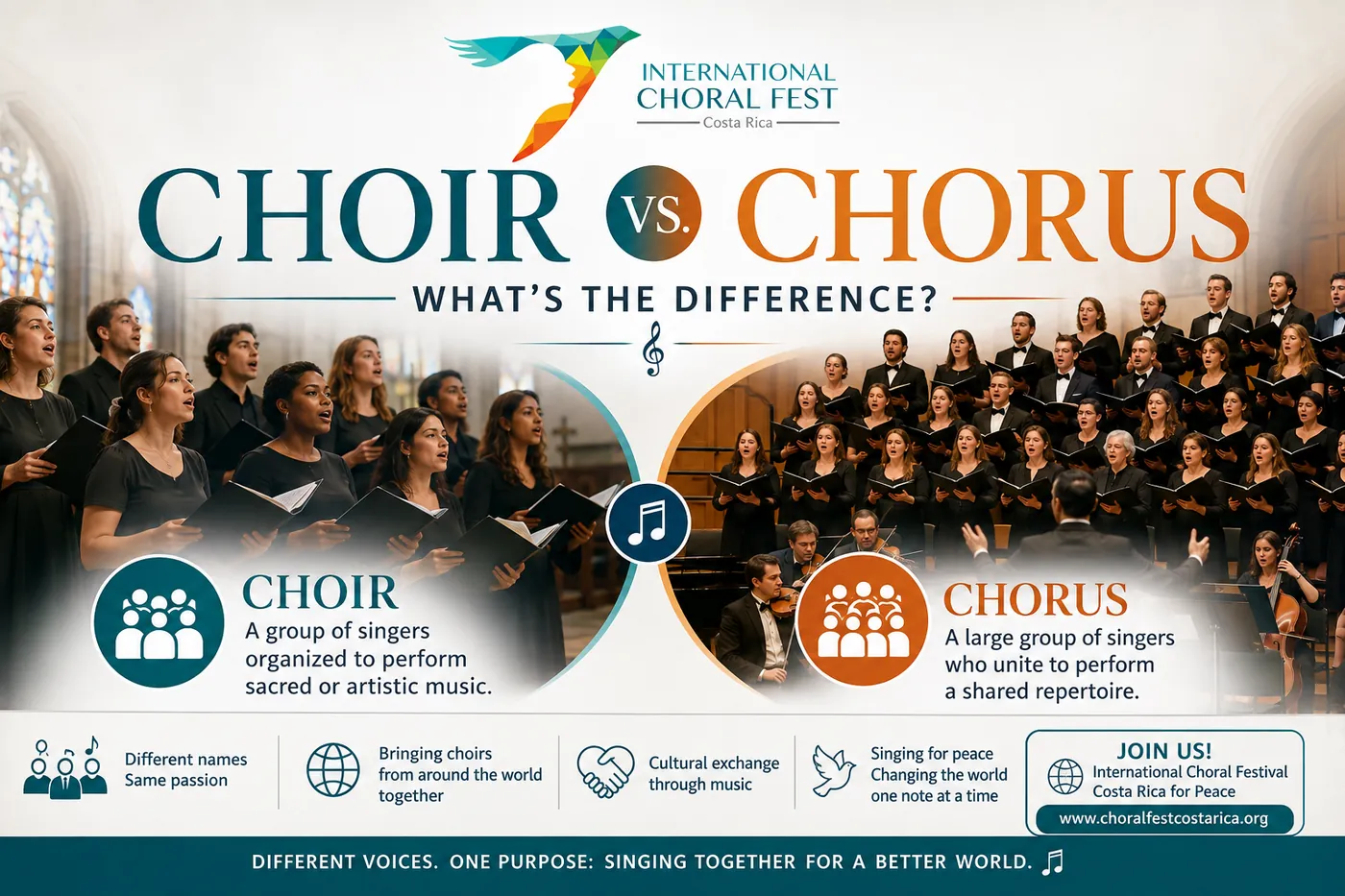
Choir vs. chorus: both words describe groups of people singing together, and in many situations they can be used interchangeably. However, their meaning may change depending on the country, musical tradition and performance context.
In general, choir is the more common term for an organized vocal ensemble, especially in schools, churches and community settings. Chorus may refer to a large singing group, the singers in an opera or musical, or the repeated section of a song.
Choir vs. Chorus: Main Differences at a Glance
| Feature | Choir | Chorus |
|---|---|---|
| General meaning | An organized group of singers | A group of singers or a repeated section of a song |
| Common settings | Churches, schools, universities, communities and concert halls | Opera, musical theater, large concert ensembles and popular songs |
| Typical size | Can be small, medium or large | Often suggests a larger group, although not always |
| Repertoire | Sacred, classical, folk, gospel, contemporary and popular music | Opera, theater, symphonic works, popular music and large choral works |
| Leadership | Usually directed by a conductor or choir director | Usually directed by a conductor, chorus master or musical director |
| Use in a song | Normally refers to the singers | Can refer to the repeated musical section |
| Regional usage | Widely used internationally | Especially common in American English and theatrical contexts |
| Can the terms overlap? | Yes | Yes |
What Is a Choir?
A choir is an organized ensemble of singers who rehearse and perform together. Choirs may sing with instrumental accompaniment or a cappella, and they can perform music from many periods, languages and cultural traditions.
The word is commonly used for church choirs, school choirs, university choirs, children’s choirs, chamber choirs, community choirs and professional vocal ensembles.
A choir is normally divided into voice parts. The most familiar mixed-voice structure is SATB:
- Soprano: the higher female or treble voice part.
- Alto: the lower female or treble voice part.
- Tenor: the higher adult male voice part.
- Bass: the lower adult male voice part.
Other ensembles may use different combinations, including SSA, SSAA, TTBB, SAB or unison singing.
Common Types of Choirs
- Children’s choir: an ensemble of young singers, often using treble voices.
- Youth choir: a group for adolescents or young adults.
- School choir: an ensemble connected to a primary or secondary school.
- University choir: a collegiate ensemble that may include music students and singers from other disciplines.
- Church choir: a group that supports worship and performs sacred repertoire.
- Community choir: an ensemble open to singers from a local area.
- Chamber choir: a smaller ensemble that often performs detailed or demanding repertoire.
- Professional choir: an ensemble whose singers are paid for rehearsals and performances.
- Show choir: a group combining singing with choreography and theatrical presentation.
- Virtual choir: singers recorded separately and combined through digital technology.
What Is a Chorus?
A chorus is also a group of singers, but the word has several distinct meanings.
In American English, chorus is often used for a large vocal ensemble. A symphony chorus, opera chorus or festival chorus may include many singers performing with an orchestra or theatrical production.
In opera and musical theater, the chorus represents groups of characters within the story. Its members may sing, move, dance and act while supporting the dramatic action.
The word chorus can also refer to the repeated section of a song. In popular music, the chorus usually returns several times and contains the main musical or lyrical idea.
The Chorus in Opera
An opera chorus may represent citizens, soldiers, villagers, pilgrims, workers or other groups within the drama. The singers must combine vocal precision with theatrical movement, characterization and awareness of the stage.
Opera companies often employ a chorus master who prepares the singers before rehearsals with the principal conductor and stage director.
The Chorus in Musical Theater
In musical theater, the chorus traditionally referred to the ensemble supporting the principal characters. Modern productions often use the word ensemble instead.
These performers may sing, dance, act, change roles and help create the visual and dramatic world of the production.
The Chorus of a Song
In song structure, the chorus is the section that repeats after each verse. It often contains the title, central message or most memorable melody.
This meaning is different from a chorus as a group of singers. Context normally makes the intended meaning clear.
Are Choir and Chorus the Same Thing?
They can be. Many vocal ensembles could accurately be described as either a choir or a chorus.
For example, a large community ensemble might call itself a community choir, civic chorus or choral society. The choice often depends on local tradition, organizational identity and the type of repertoire performed.
The distinction is therefore not a strict musical rule. It is more useful to understand the contexts in which each word is commonly used.
Regional Differences in Usage
In British and international English, choir is usually the most familiar general term for a singing ensemble.
In the United States, both words are common. Schools may use choir or chorus for student ensembles, while large organizations often use names such as symphony chorus, civic chorus or master chorale.
In other languages, the same word may cover both concepts. Spanish uses coro, Portuguese uses coro or coral, Italian uses coro, and French uses chœur.
Because terminology varies, the ensemble’s official name should normally be respected when translating, promoting or introducing it.
Choir, Chorus and Chorale
The word chorale can create additional confusion because it also has more than one meaning.
Historically, a chorale is a Lutheran hymn tune. Johann Sebastian Bach used chorales extensively in cantatas, Passions and other sacred works.
In the names of modern organizations, chorale may simply suggest a formal or large vocal ensemble. Examples include symphonic chorales, master chorales and community chorales.
Therefore:
- Choir: a general term for an organized singing ensemble.
- Chorus: a singing ensemble, an opera or theater group, or the repeated part of a song.
- Chorale: historically a Lutheran hymn, but also used in the names of modern ensembles.
Does Ensemble Size Determine the Name?
Not necessarily. A choir can be very small or extremely large, and a chorus can also vary greatly in size.
A chamber choir may have fewer than twenty singers, while a festival choir may include hundreds. A professional opera chorus may be smaller than a large community choir.
The name alone does not reliably indicate the number of singers. It is better to examine the ensemble’s repertoire, purpose and organizational description.
Do Choirs and Choruses Sing Different Music?
There is no fixed repertoire that belongs exclusively to one term.
Choirs and choruses may perform:
- Gregorian chant and Renaissance polyphony;
- motets and madrigals;
- Masses, cantatas, Passions and oratorios;
- Classical and Romantic choral works;
- opera and musical-theater repertoire;
- gospel, spirituals and folk music;
- jazz, popular and contemporary music;
- traditional music from different cultures.
The ensemble’s identity and artistic mission matter more than the word used in its name.
Choir and Chorus in Choral History
Groups of singers have been central to religious, theatrical and community life for centuries. Ancient Greek drama used a chorus to comment on the action, while Christian worship developed organized groups of singers associated with churches, monasteries and cathedrals.
During the Renaissance, vocal ensembles performed sacred motets and secular madrigals. Later periods expanded the role of large choruses in oratorios, operas, symphonies and public festivals.
Readers can explore this development in our guides to the history of choral music and the evolution of choral music from Gregorian chant to contemporary choirs.
Related vocal forms are explained in our comparisons of oratorio vs. cantata and motet vs. madrigal.
How to Choose a Name for a New Singing Group
When creating a new ensemble, the name should communicate its identity clearly to singers, audiences and potential partners.
Consider the Ensemble’s Purpose
A church choir, children’s chorus, chamber choir and symphonic chorus create different expectations. Choose a term that reflects the group’s principal activity.
Respect Regional Usage
Use language that feels natural in the community where the ensemble operates. A term that is familiar in one country may sound unusual in another.
Think About Repertoire
A group specializing in Renaissance music may prefer chamber choir or vocal ensemble, while a large ensemble performing with an orchestra may choose symphony chorus or choral society.
Make the Name Easy to Find
A clear and distinctive name helps with websites, social media, event programs and search engines. Avoid a name that is easily confused with another ensemble in the same region.
Preserve the Official Identity
Once an ensemble has established a recognized name, use it consistently in programs, recordings, correspondence and international festival applications.
Frequently Asked Questions About Choirs and Choruses
What is the main difference between a choir and a chorus?
Choir is the most common general term for an organized singing ensemble. Chorus may mean a singing ensemble, especially a large or theatrical one, but it can also mean the repeated section of a song.
Is a chorus larger than a choir?
Not necessarily. Chorus sometimes suggests a large ensemble, but both choirs and choruses can range from small chamber groups to organizations with hundreds of singers.
Is a church singing group called a choir or a chorus?
It is most commonly called a church choir, although some organizations may use chorus in their official name.
Why do American schools use the word chorus?
Chorus is a common American term for a school singing ensemble. Other schools use choir, and there is no important musical difference between the two names.
What is an opera chorus?
An opera chorus is the ensemble of singers who represent groups of characters within an opera. Members sing and may also act or move as part of the dramatic production.
What does chorus mean in a song?
The chorus is the repeated section that normally contains the song’s central message, title or most memorable melody.
What is the difference between a chorus and a chorale?
Chorus is a general term for a singing ensemble or part of a song. Chorale historically refers to a Lutheran hymn, although the word is also used in the names of modern choral organizations.
Can a choir participate in an international choral festival?
Yes. Children’s, youth, university, church, community, chamber and professional choirs can participate in international festivals, depending on each event’s requirements.
Conclusion
Choir and chorus often describe the same basic idea: people combining their voices to create music together. The difference lies mainly in usage and context rather than in a strict musical definition.
Choir is the broadest and most internationally familiar term. Chorus is especially common for large ensembles, opera and theater groups, and the repeated section of a song.
Whatever name an ensemble chooses, its success depends on listening, cooperation, musical preparation and the shared commitment of its singers.
Bring Your Choir or Chorus to Costa Rica
The International Choral Festival in Costa Rica for Peace welcomes ensembles with different names, traditions, ages and musical styles.
Whether your group identifies as a choir, chorus, chorale or vocal ensemble, Choral Fest Costa Rica offers a non-competitive space for concerts, workshops, cultural exchange and friendship through music.
Apply with your choir → or explore the festival to learn more.