
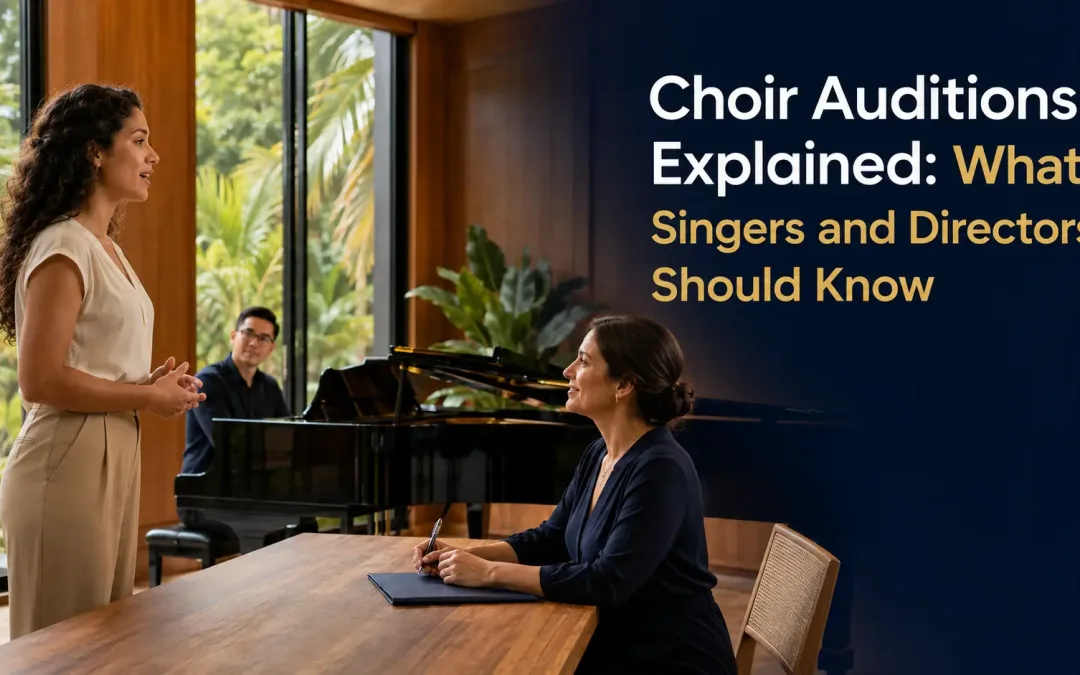
Choir auditions help directors understand a singer’s vocal range, musical experience, listening skills and suitability for a particular ensemble. For singers, an audition is an opportunity to show preparation, vocal health, musical potential and the ability to respond constructively to direction.
This guide explains what happens in a choir audition, how singers can prepare, what directors should evaluate, how voice placement differs from selection and how to create an audition process that is clear, respectful and appropriate for the choir’s purpose.
Understanding choir auditions helps singers prepare with confidence and helps directors build a fair, useful process that matches the goals of the ensemble.
Choir Auditions at a Glance
| Audition element | What the director observes | What the singer should prepare |
|---|---|---|
| Prepared song | Tone, phrasing, diction and musical expression | A suitable piece learned securely |
| Vocal range | Comfortable high and low notes | Healthy singing without forcing |
| Pitch matching | Ability to reproduce notes accurately | Focused listening and calm repetition |
| Rhythm | Pulse, subdivision and coordination | Basic counting and rhythmic practice |
| Sight-singing | Ability to read unfamiliar music | Clefs, intervals, rhythm and tonal awareness |
| Harmony | Part independence and listening | Ability to maintain one line against another |
| Vocal flexibility | Response to different vowels, dynamics and styles | Willingness to adjust without tension |
| Conversation | Experience, goals, availability and expectations | Honest information about commitment and background |
What Is a Choir Audition?
A choir audition is a structured opportunity for a director to hear and evaluate a singer before assigning them to a section or offering membership.
The process may include:
- a prepared song;
- vocal exercises;
- range testing;
- pitch matching;
- rhythm exercises;
- sight-singing;
- harmony singing;
- a short conversation;
- a trial rehearsal.
The exact format depends on the ensemble. A professional chamber choir may require advanced sight-reading and stylistic flexibility, while a community choir may use a simple voice-placement session rather than a competitive audition.
See types of choirs to compare the expectations of community, school, university, chamber and professional ensembles.
Audition vs. Voice Placement
One of the most important distinctions in choir auditions is whether the process determines membership or simply helps place a singer in the right section.
An audition and a voice-placement session are not always the same.
Audition
An audition may determine whether a singer is accepted into the choir.
Voice Placement
A voice-placement session helps the director decide which section best suits the singer.
Open community, church and school choirs often welcome all participants and use placement only to assign soprano, alto, tenor, bass or another part.
Directors should explain clearly whether the process is selective, developmental or simply organizational.
Why Choirs Hold Auditions
Choirs may use auditions to:
- identify healthy vocal range and tessitura;
- balance sections;
- evaluate musicianship;
- confirm sight-reading ability;
- select singers for advanced repertoire;
- understand vocal experience;
- determine whether the singer can meet rehearsal and concert commitments;
- protect the artistic goals of the ensemble;
- place singers appropriately.
An audition should serve the choir’s mission rather than exist only to create exclusivity.
Different Types of Choir Auditions
Open Community Choir Audition
This is often a brief and supportive session focused on range, pitch matching and section placement.
School or Youth Choir Audition
The director may evaluate musical potential, confidence, changing voices, attendance and developmental needs.
University Choir Audition
This may include a prepared song, sight-singing, tonal memory, rhythm and previous ensemble experience.
Chamber Choir Audition
A chamber choir usually requires stronger independence, secure intonation, advanced reading and the ability to blend in a smaller ensemble.
Professional Choir Audition
Professional auditions may involve prepared repertoire, excerpts, advanced sight-reading, stylistic contrasts, language skills and several callback rounds.
Opera Chorus Audition
An opera chorus may evaluate vocal power, range, language, movement, acting awareness and the ability to sing with orchestra.
What Singers Should Expect
Preparation for choir auditions should focus on healthy singing, clear instructions, musical readiness and calm responsiveness.
Most choir auditions begin with a short introduction and explanation of the process.
The singer may then be asked to:
- sing a prepared piece;
- complete vocal exercises;
- match pitches;
- repeat short melodic patterns;
- clap or speak rhythms;
- read a short musical excerpt;
- sing one part while another line is played;
- answer questions about experience and availability.
Not every choir uses every element.
How to Choose an Audition Song
A suitable audition song should show the singer’s voice clearly without creating unnecessary technical difficulty.
Choose music that:
- fits your comfortable range;
- shows clear phrasing;
- allows good diction;
- matches the requested style;
- can be performed confidently;
- does not depend on extreme notes;
- can be accompanied when required.
Avoid Songs That Hide the Voice
Highly theatrical, heavily amplified or excessively ornamented music may make it difficult for the director to hear basic vocal qualities.
Follow the Audition Instructions
If the choir requests a sacred piece, art song, folk song or unaccompanied excerpt, prepare exactly that.
Ignoring instructions may suggest poor preparation even when the singer performs well.
Should You Sing A Cappella?
Some auditions require a cappella singing because it reveals:
- pitch stability;
- internal pulse;
- tonal memory;
- vocal independence;
- confidence without instrumental support.
Other auditions use piano accompaniment to support the singer and evaluate musical collaboration.
Our guide to a cappella vs. accompanied choir explains the demands of both formats.
How Directors Test Vocal Range
In choir auditions, range testing should identify comfort and tessitura rather than reward extreme notes.
The director may guide the singer through ascending and descending patterns on vowels or simple syllables.
The purpose is not to discover the most extreme possible note. It is to understand:
- comfortable range;
- tessitura;
- register transitions;
- tone color;
- vocal flexibility;
- possible section placement;
- areas of tension or fatigue.
Range Is Not the Same as Tessitura
A singer may reach one high or low note briefly but remain uncomfortable if most of the part stays in that area.
Tessitura is often more important for long-term choir placement.
How Directors Place SATB Singers
Section placement should consider more than gender or isolated notes.
Directors should evaluate:
- comfortable tessitura;
- vocal color;
- register transitions;
- musical independence;
- section balance;
- vocal health;
- the singer’s experience and preferences.
Our guide to SATB voice parts explains soprano, alto, tenor and bass in greater detail.
Directors should also connect section placement with how to choose music for your choir so repertoire fits the singers who are actually available.
Pitch-Matching Exercises
The director may play or sing one note and ask the singer to repeat it.
Later exercises may include:
- two-note patterns;
- three-note patterns;
- stepwise melodies;
- small leaps;
- major and minor triads;
- short tonal phrases.
Pitch matching tests listening and vocal coordination rather than polished performance.
Rhythm Tests
A rhythm test may ask the singer to:
- clap a printed rhythm;
- repeat a rhythm by ear;
- speak counts aloud;
- maintain pulse while reading rests;
- perform syncopation;
- respond to changing meter.
Singers should continue counting during silence rather than treating rests as empty time.
Sight-Singing in a Choir Audition
Sight-singing means performing unfamiliar music with little or no preparation.
The excerpt may evaluate:
- note reading;
- rhythm;
- key awareness;
- interval recognition;
- tonal memory;
- recovery after mistakes.
How to Prepare Before Singing
When given an excerpt:
- Check the clef.
- Identify the key signature.
- Check the time signature.
- Find the starting pitch.
- Scan the rhythm.
- Notice accidentals.
- Identify difficult intervals.
- Establish the pulse before beginning.
Our guide to how to read choral music explains these skills step by step.
For more complete rehearsal preparation, use vocal warm-ups for choirs and breathing techniques for choir singers.
What If You Make a Mistake?
One error does not necessarily end an audition.
Directors often observe whether the singer can:
- recognize the problem;
- continue without panic;
- accept a correction;
- try the passage again;
- improve after guidance.
Musical responsiveness can be as valuable as immediate perfection.
Harmony Tests
A singer may be asked to maintain one line while the director or pianist performs another.
This reveals:
- part independence;
- harmonic hearing;
- confidence;
- ability to resist following the melody;
- listening and adjustment.
Our article on how to sing in harmony provides practical exercises for these skills.
For ensemble listening after placement, continue with choir blend and balance and choir intonation.
Language and Diction
Some auditions include text in Latin, German, Italian, French, Spanish or another language.
The director may evaluate:
- clarity;
- vowel consistency;
- consonant timing;
- openness to correction;
- ability to imitate pronunciation.
Perfect fluency is not always expected, but preparation and flexibility matter.
What Directors Should Evaluate
Directors should design choir auditions around the actual needs of the ensemble, not around irrelevant or intimidating tests.
A choir audition should measure qualities connected directly to the ensemble’s needs.
Possible criteria include:
- vocal health;
- tone quality;
- comfortable range;
- intonation;
- rhythm;
- sight-reading;
- diction;
- part independence;
- musical expression;
- response to feedback;
- reliability;
- availability.
What Directors Should Not Assume
Directors should avoid judging singers according to:
- appearance;
- age alone;
- gender stereotypes;
- accent;
- formal education alone;
- nervousness during the first minute;
- one isolated high or low note;
- personal similarity to existing members.
The evaluation should remain relevant, consistent and respectful.
Create a Clear Audition Rubric
A rubric helps directors evaluate singers consistently.
| Criterion | Possible evidence |
|---|---|
| Pitch | Matches notes and maintains tonal center |
| Rhythm | Maintains pulse and performs written values accurately |
| Vocal production | Sings with healthy coordination and manageable tension |
| Range and tessitura | Shows a comfortable area suitable for ensemble placement |
| Diction | Produces clear vowels and coordinated consonants |
| Musicianship | Reads, listens and responds accurately |
| Responsiveness | Improves after instruction |
| Commitment | Can meet rehearsal and performance expectations |
Keep the Audition Appropriate to the Choir
A beginner choir should not use the same audition standard as a professional ensemble.
Directors starting a new group can use how to start a choir to connect recruitment, auditions, section balance and rehearsal planning.
For a community choir, the director may prioritize:
- pitch matching;
- comfortable range;
- willingness to learn;
- attendance;
- group compatibility.
For an advanced chamber choir, the director may require:
- strong sight-reading;
- secure intonation;
- stylistic flexibility;
- independent singing;
- language skills;
- small-ensemble experience.
How to Reduce Audition Anxiety
Nervousness is common and does not necessarily reflect a singer’s real ability.
Singers can reduce anxiety by:
- preparing early;
- choosing suitable repertoire;
- practicing the opening several times;
- arriving early;
- bringing organized music;
- breathing calmly;
- accepting that small mistakes may happen.
Directors can help by:
- explaining the process;
- using respectful language;
- allowing a short warm-up;
- avoiding unnecessary intimidation;
- giving clear starting pitches;
- providing reasonable preparation time.
What to Bring to a Choir Audition
Depending on the ensemble, bring:
- printed music;
- an extra copy for the pianist;
- a pencil;
- water;
- requested forms;
- a résumé or list of experience;
- calendar information;
- appropriate identification when required.
Music should be clearly marked and easy to open.
How to Work With an Audition Pianist
Before singing:
- show the beginning and ending;
- indicate tempo;
- mark cuts or repeats;
- explain whether an introduction is needed;
- avoid giving a long verbal interpretation.
Do not blame the pianist if something unexpected happens. Continue musically and recover when possible.
What to Wear
Choose clothing that is:
- comfortable;
- appropriate to the organization;
- easy to breathe and move in;
- neat without distracting from the singing.
A choir audition usually does not require formal concert clothing unless the organization specifies it.
Questions Singers Should Ask
An audition is also an opportunity for the singer to understand the choir.
Useful questions include:
- How often does the choir rehearse?
- What attendance is expected?
- Are there membership fees?
- What repertoire does the choir perform?
- Are singers expected to practice independently?
- How many concerts occur each season?
- Does the choir travel?
- Are uniforms required?
- How are section placements reviewed?
After the Audition
The organization should explain:
- when results will be communicated;
- whether callbacks are required;
- how placement decisions are made;
- when rehearsals begin;
- what materials are needed;
- whether a trial period applies.
Directors should avoid leaving singers without information for an unreasonable period.
Callbacks
A callback is a second audition used when the director needs more information.
It may include:
- singing with current members;
- more difficult sight-reading;
- additional repertoire;
- small-ensemble work;
- movement or acting;
- a rehearsal observation.
Trial Periods
Some choirs accept singers provisionally for several rehearsals.
A trial period can help evaluate:
- attendance;
- section fit;
- learning speed;
- ensemble behavior;
- response to rehearsal expectations.
Conditions should be explained clearly from the beginning.
When a Singer Is Not Selected
Rejection does not always mean the singer lacks ability.
Possible reasons include:
- section balance;
- limited vacancies;
- specific repertoire needs;
- schedule conflict;
- required reading level;
- current vocal fit.
When possible, directors should offer brief, respectful feedback and suggest appropriate next steps.
Ethical Choir Auditions
A responsible audition process should be:
- transparent;
- relevant to the choir;
- consistent;
- respectful;
- accessible where possible;
- free from humiliation;
- confidential;
- appropriately documented.
Children and vulnerable participants require suitable safeguarding procedures and parental or institutional communication where applicable.
Auditions for Children and Youth
Auditions for young singers should focus on development and potential rather than adult vocal standards.
Appropriate activities may include:
- echo singing;
- simple pitch matching;
- rhythm imitation;
- short familiar songs;
- comfortable range exploration;
- conversation about interest and availability.
Changing voices should be treated with flexibility and respect.
Auditions for Community Choirs
Community ensembles often benefit from a welcoming process.
A short placement session may include:
- one familiar song;
- simple scales;
- range check;
- pitch matching;
- brief harmony exercise;
- discussion of experience.
The goal is often appropriate placement and support rather than exclusion.
Auditions for Advanced and Professional Choirs
Advanced auditions may require:
- contrasting prepared pieces;
- advanced sight-singing;
- language proficiency;
- stylistic flexibility;
- quick musical adjustment;
- small-ensemble singing;
- professional reliability.
Requirements should be communicated well in advance.
Common Choir Audition Mistakes
- Choosing unsuitable repertoire: the song sits outside the singer’s comfortable range.
- Ignoring instructions: the prepared material does not match the request.
- Singing too loudly: nerves create tension and poor control.
- No score preparation: cuts, tempo and accompaniment are unclear.
- Stopping after a small error: the singer does not demonstrate recovery.
- Pretending to have skills not yet developed: expectations become unrealistic.
- Directors using irrelevant tests: the audition does not match the choir’s needs.
- No clear communication: singers do not understand the process or result.
- Judging only vocal size: musicianship and ensemble suitability are ignored.
- Using fear as motivation: the audition becomes unnecessarily harmful.
A 7-Day Choir Audition Preparation Plan
| Day | Preparation task |
|---|---|
| Day 1 | Read all instructions and choose repertoire |
| Day 2 | Practice notes, rhythm and text slowly |
| Day 3 | Work on phrasing, diction and breath |
| Day 4 | Practice sight-singing and pitch matching |
| Day 5 | Sing with accompaniment or a practice track |
| Day 6 | Perform a complete mock audition |
| Day 7 | Light review, rest and organize materials |
Frequently Asked Questions About Choir Auditions
What happens at a choir audition?
You may sing a prepared song, complete range and pitch exercises, read a short excerpt and discuss your experience and availability.
Do all choirs require auditions?
No. Many community, church and educational choirs use open membership or simple voice-placement sessions.
What song should I sing for a choir audition?
Choose a piece that fits your comfortable range, shows clear phrasing and follows the choir’s instructions.
Do I need to sight-read music?
It depends on the choir. Advanced and professional ensembles often require sight-reading, while beginner choirs may not.
What if I make a mistake during the audition?
Continue when possible, listen carefully and respond to correction. Directors often value recovery and flexibility.
How do directors decide my voice part?
They consider range, tessitura, tone color, register transitions, vocal health and section balance.
Can I audition if I have never sung in a choir?
Yes, especially for beginner or community ensembles. Be honest about your experience and willingness to learn.
What should I do if I am not accepted?
Ask for respectful feedback when available, continue training and consider another ensemble that better matches your current level or voice.
How long does a choir audition usually take?
Many individual auditions last between 10 and 20 minutes, although professional auditions and callbacks may take longer.
Do I need a classical song for a choir audition?
Not always. Follow the choir’s instructions. The best piece is one that fits the requested style, sits comfortably in your range and lets the director hear your natural voice clearly.
Can I audition for a choir if I cannot read music?
Yes, depending on the ensemble. Community, church and beginner choirs may not require sight-reading, while advanced and professional choirs often do.
Should I warm up before a choir audition?
Yes. Use a short, gentle warm-up that prepares breath, resonance, vowels and range without tiring the voice.
What should I wear to a choir audition?
Wear neat, comfortable clothing that allows easy breathing and movement unless the organization gives specific instructions.
How do directors decide between soprano and alto, or tenor and bass?
They consider tessitura, tone color, register transitions, endurance, vocal health, musicianship and section balance rather than only the highest or lowest note.
What if I am nervous and sing worse than usual?
Directors should expect some nervousness. A good audition process looks at overall potential, preparation and response to guidance rather than judging only the first minute.
Can I ask for feedback after a choir audition?
Yes, when the organization allows it. Brief, specific feedback can help you understand section placement, musicianship goals or what to improve before another audition.
Conclusion
Well-designed choir auditions help singers and directors find the right musical fit while supporting healthy voices, clear expectations and respectful ensemble culture.
Choir auditions should help singers and directors determine whether an ensemble is a healthy and appropriate musical match.
Singers should prepare honestly, choose suitable repertoire and remain open to feedback. Directors should evaluate only the skills relevant to the choir and communicate expectations clearly.
A strong audition process does not depend on intimidation. It reveals vocal potential, musicianship, reliability and the ability to contribute to a shared ensemble.
Prepare Your Choir for an International Festival
As singers and ensembles grow, festivals can provide new opportunities for performance, learning and cultural exchange.
The International Choral Festival in Costa Rica for Peace welcomes children’s, youth, school, university, church, community and advanced choirs in a non-competitive environment.
Apply with your choir → or explore Choral Fest Costa Rica to learn more.