
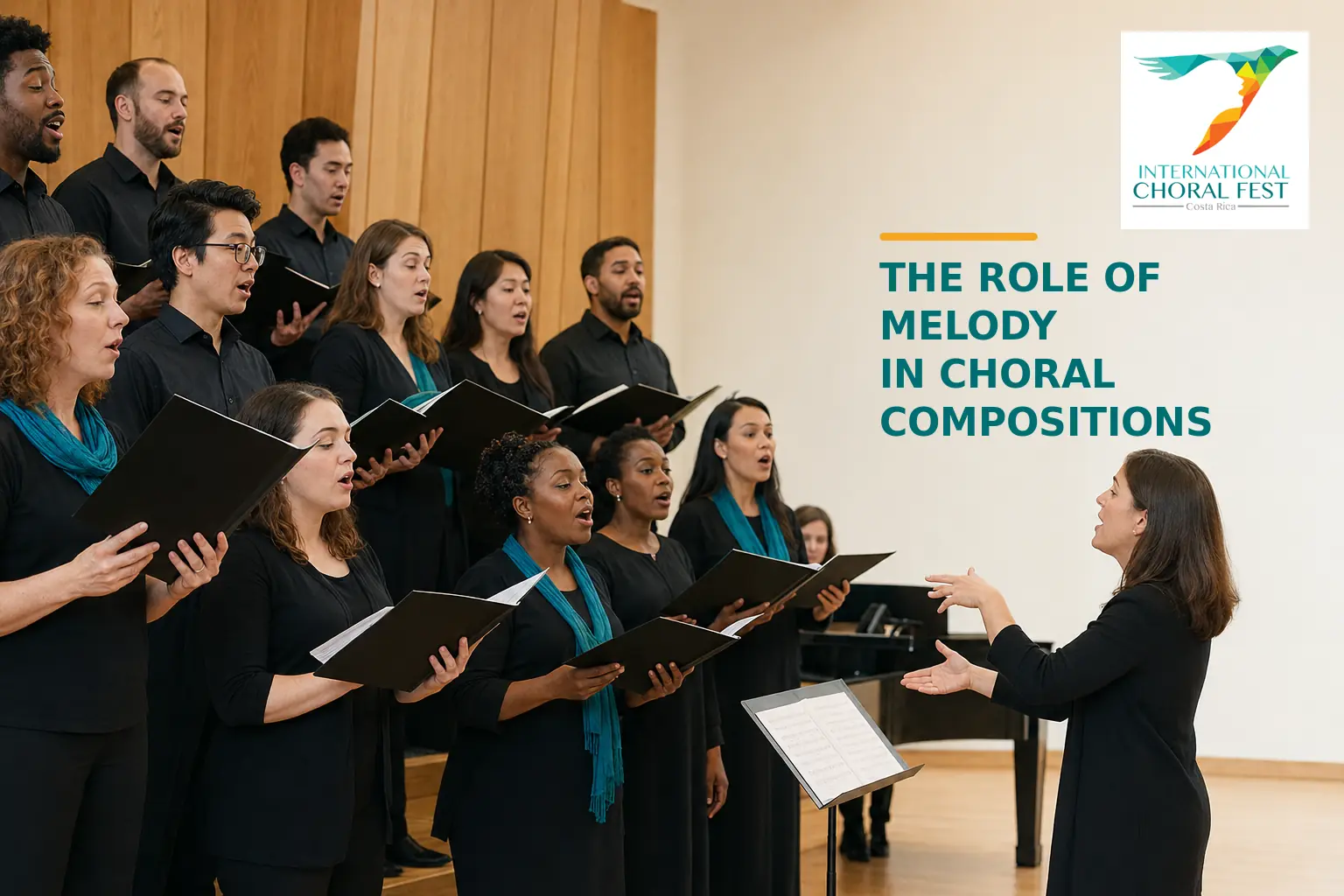
The role of melody in choral compositions is central to how singers and listeners understand musical direction. Melody carries memorable musical ideas, shapes phrasing, supports text expression and often guides the emotional journey of a choral work.
This guide explains what melody is, how it functions inside choral texture, what makes a melody effective, how composers shape melodic contour and repetition, and how singers can support melodic clarity within an ensemble.
Melody in Choral Music at a Glance
| Element | Role in choral writing |
|---|---|
| Contour | Shapes the rise and fall of the musical line |
| Range | Determines vocal comfort and dramatic reach |
| Rhythm | Gives the melody motion and character |
| Text setting | Connects words with musical emphasis |
| Repetition | Makes ideas memorable and structurally clear |
| Variation | Prevents predictability and supports development |
What Is Melody?
Melody is a sequence of notes perceived as a coherent musical line. It is often the part listeners remember most easily and may carry the principal theme, text or emotional focus of a piece.
In choral music, melody may appear in soprano, alto, tenor, bass or move between sections. It can also be shared, imitated or distributed across several voices.
For a broader view of how melodic lines interact, see Polyphony in Music and Counterpoint in Choral Music.
Why Melody Matters in Choral Music
The role of melody in choral compositions is especially important because singers must understand not only their own notes, but also which line currently carries the musical focus.
Creating Emotional Impact
Melodic shape can communicate joy, tension, calm, longing, grief or hope. Rising lines may create aspiration or momentum, while descending contours can suggest release or reflection.
Providing Structure and Coherence
Strong melodic ideas help listeners recognize themes, transitions and returns. Repeated or transformed melodies can unify a long choral work.
Enhancing Textual Meaning
Composers often shape melody around word stress, syntax and emotional meaning. Important words may receive higher notes, longer durations, repeated pitches or distinctive intervals.
Creating Musical Hierarchy
Melody helps determine which section should be heard most clearly at a given moment. This directly affects ensemble balance.
For practical work on this relationship, see Choir Blend and Balance.
Characteristics of an Effective Choral Melody
Simplicity and Singability
A singable melody usually fits the comfortable range and tessitura of the intended singers. It should be memorable without becoming monotonous.
Repetition and Variation
Repetition reinforces important musical ideas, while variation keeps them alive. Composers may alter rhythm, harmony, register, dynamics or orchestration while preserving melodic identity.
Contour and Movement
A clear melodic contour helps singers understand direction. Stepwise motion often feels smooth, while larger intervals can create emphasis or dramatic contrast.
Rhythmic Identity
Melody is defined not only by pitch, but also by rhythm. A distinctive rhythmic pattern can make a melodic idea immediately recognizable.
Harmonic Support
The melody should interact meaningfully with surrounding harmony. A note may function as consonance, suspension, dissonance or passing tone depending on the harmonic context.
For tuning these relationships in rehearsal, see How to Improve Choir Intonation.
Melody Inside Choral Texture
The role of melody in choral compositions changes according to texture.
Homophonic Texture
One voice, often soprano, may carry the main melody while the other sections support it harmonically.
Polyphonic Texture
Several melodic lines may be equally important. Musical focus shifts as themes move between sections.
Unison Texture
The entire choir may sing one melody together, emphasizing textual clarity and collective sound.
Imitative Texture
A melodic idea may begin in one section and then appear in another, creating dialogue across the ensemble.
These relationships are explored further in How to Sing in Harmony.
Famous Choral Melody Examples
Johann Sebastian Bach — Jesu, Joy of Man’s Desiring
This work is remembered for its flowing melodic line and the way the melody interacts with surrounding accompaniment and harmony.
Gabriel Fauré — Cantique de Jean Racine
Fauré uses lyrical melodic writing to support reverence, calm and textual flow.
Eric Whitacre — Lux Aurumque
Whitacre’s writing shows how melody can emerge from a rich harmonic texture rather than functioning as a continuously dominant line.
Tips for Composers Writing Choral Melodies
Understand the Text
Let syntax, word stress and emotional meaning shape melodic direction.
Respect Vocal Range and Tessitura
Write for sustainable singing rather than only dramatic extreme notes.
Use Repetition Strategically
Repeat important ideas, but vary them enough to preserve interest.
Shape the Contour
Consider where the melody rises, falls, rests and reaches its highest point.
Consider the Harmonic Context
Ask how the melody interacts with chord function, dissonance and resolution.
Directors and composers can also consult How to Choose Music for Your Choir and Choir Repertoire Planning.
Tips for Singers and Directors
Identify Who Has the Melody
Singers should know when their section carries the main line and when it supports another voice.
Shape the Phrase
Melody needs direction. Avoid singing every note with equal weight.
Use Breath to Support the Line
Good breath planning helps maintain melodic continuity. See Breathing Techniques for Choir Singers.
Coordinate Articulation
Staccato, legato, consonants and vowel timing all affect how a melody is perceived. See Staccato vs. Legato.
Balance the Ensemble Around the Melody
When one section has important material, supporting voices may need to reduce volume or simplify color so the melody remains clear.
For the broader practical framework, see the Complete Guide to Choir Singing.
Frequently Asked Questions About Melody in Choral Music
What is melody in choral music?
Melody is a coherent sequence of pitches and rhythms that forms a recognizable musical line within a choral composition.
Which choir section usually sings the melody?
Soprano often carries the melody in traditional homophonic SATB writing, but melody can move to alto, tenor or bass depending on the composition.
Can more than one section have a melody at the same time?
Yes. In polyphonic and contrapuntal music, several independent melodic lines may be active simultaneously.
What makes a melody easy to sing?
Comfortable range, logical contour, manageable intervals, clear rhythm and natural text stress usually improve singability.
How does melody affect choir balance?
The section carrying the principal melody may need temporary prominence while accompanying or harmonic lines support it.
How does text influence melody?
Composers often use melodic contour, rhythm and pitch emphasis to reinforce word meaning, syntax and emotion.
What is the difference between melody and harmony?
Melody is a sequence of notes heard as a line over time, while harmony describes how notes sound together vertically.
What is the difference between melody and counterpoint?
Melody is a single coherent musical line. Counterpoint is the technique of combining several independent melodic lines.
Can a choir sing without a clear melody?
Yes. Some choral works emphasize texture, harmony, atmosphere or overlapping lines rather than a continuously dominant melody.
Why is melody important for singers?
Understanding melodic direction helps singers shape phrases, communicate text and recognize their musical role within the ensemble.
Conclusion
The role of melody in choral compositions goes far beyond carrying a tune. Melody organizes musical direction, supports text, shapes emotion and helps define which voice should be heard at each moment.
For composers, it is a tool for structure and expression. For directors, it guides phrasing and balance. For singers, it gives each line purpose within the complete choral texture.
Hear Melody Come Alive at Choral Fest Costa Rica
Melodic lines become especially meaningful when singers from different countries share music together at the International Choral Festival in Costa Rica for Peace.
Apply with your choir → or explore the festival to learn more.
Plan Your Choir’s Journey
Explore what a choir trip to Costa Rica looks like, review the costs and logistics, or get in touch with our team.