
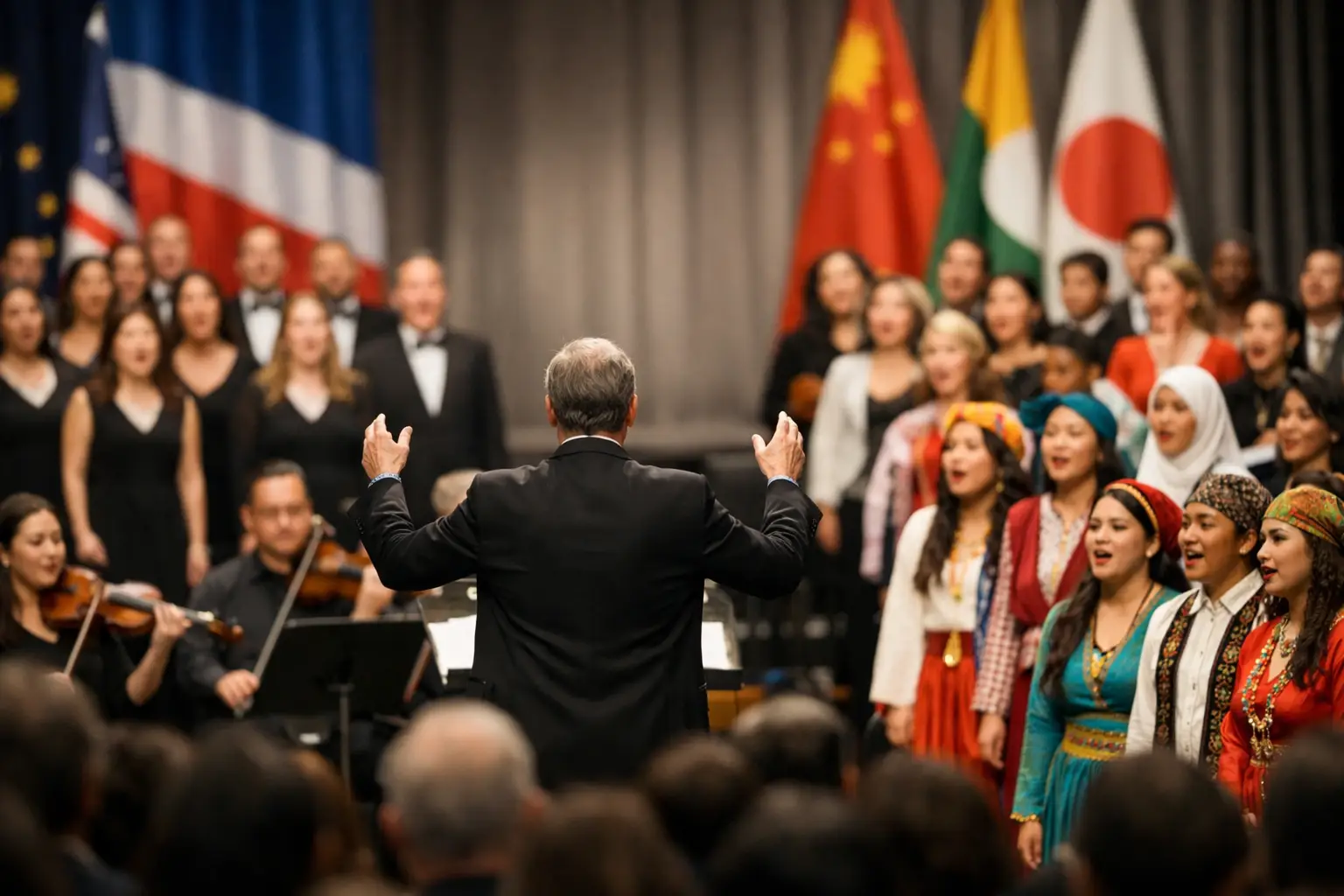
A powerful choir diplomacy concert example does not begin when the audience takes its seat. It begins months earlier, when singers in different countries learn music that asks them to listen beyond their own language, style, and assumptions. By the time they stand together onstage, the concert has become more than a performance. It is a public act of welcome.
For choir directors planning international travel, this matters. A memorable tour should offer more than a beautiful venue and a polished program. It should give singers a reason to understand why they are traveling, whom they are meeting, and what their shared music can contribute to the community around them.
What makes a concert an act of diplomacy?
Diplomacy is often associated with formal meetings and national leaders. Choral diplomacy works differently. It creates person-to-person relationships through a shared artistic task: breathing together, shaping a phrase together, and giving space to voices that may not sound or speak alike.
A concert becomes diplomatic when its design encourages mutual exchange rather than one group simply presenting itself to another. That means local singers are not treated as an opening act, a backdrop, or an audience-building tool. They are musical partners with their own history, repertoire, and perspective.
The goal is not to suggest that one evening of singing can solve conflict. It cannot. The real value is more human and more durable. Singing together can replace abstraction with names, faces, friendships, and a lived experience of cooperation. For young singers especially, that lesson can shape how they see the world long after the final chord fades.
A choir diplomacy concert example in Costa Rica
Imagine an international youth choir arriving in San José for a festival centered on peace, cultural exchange, and artistic learning. The ensemble is joined by a Costa Rican school choir and a community chorus. Rather than scheduling separate sets with a brief group finale, the directors build the event around a shared musical journey.
The program opens with each choir offering one piece from its own tradition. The visiting choir may sing a work that reflects home, faith, landscape, or community. The Costa Rican ensembles present music rooted in local rhythmic life, poetry, or choral practice. A short spoken introduction from student representatives gives the audience context in both English and Spanish.
That detail is not ceremonial filler. When singers explain what a song means to them, listeners hear the music with greater care. The room understands that culture is not a costume added to an itinerary. It is a living expression carried by people.
The center of the concert is a jointly prepared work, ideally selected for both musical substance and accessibility. It might include Spanish and English text, a message of peace, or an arrangement that allows each ensemble to contribute a distinct musical color. During a pre-concert workshop, singers rehearse side by side instead of in national clusters. They trade pronunciation tips, compare vocal warm-ups, and discover the practical challenge of finding one unified sound.
The final section can invite all singers back to the stage for a simple, resonant piece the audience can understand emotionally even without knowing every word. The effect is not sameness. It is unity with visible differences still intact: different uniforms, ages, accents, and vocal traditions meeting in one shared purpose.
The work before the applause
The concert may last 90 minutes, but the diplomacy happens in the preparation. Choir leaders set the tone by making collaboration part of the artistic standard, not an optional social activity.
A successful exchange starts with repertoire chosen early enough for all groups to prepare confidently. Directors should share learning tracks, marked scores, pronunciation guides, translations, and performance expectations well before travel. If the combined work is too difficult, rehearsal time will be spent on survival rather than listening and connection. A piece that leaves room for musical generosity is often more effective than the most technically impressive selection.
Language deserves special attention. Asking singers to learn text from another culture is meaningful, but accuracy and respect matter. Explain the translation, pronunciation, and cultural context. If a song comes from a sacred, Indigenous, or tradition-specific setting, seek guidance from knowledgeable cultural bearers or musicians. Good intentions do not replace preparation.
Directors should also plan how singers will meet away from the risers. A shared meal, mixed-choir seating, a cultural activity, or a brief reflection circle can make the next rehearsal feel entirely different. Teenagers who have already laughed together over a meal are more likely to take artistic risks and offer kindness when a rehearsal becomes demanding.
Artistic excellence and peacebuilding belong together
Some leaders worry that a peace-centered concert might soften musical expectations. In practice, the opposite can be true. Singing with unfamiliar partners demands heightened attention to blend, diction, tempo, gesture, and ensemble awareness. It asks singers to become more responsive musicians.
Still, balance is essential. If the event is framed only as a moral lesson, singers may feel they are participating in a message rather than making meaningful art. If it is framed only as a showcase, the exchange can feel staged and transactional. The strongest programs honor both realities: music must be prepared with care, and the purpose behind it must be experienced sincerely.
This is why workshops and masterclasses are so valuable in an international festival setting. A recognized conductor can challenge singers technically while modeling respectful leadership across cultures. A local clinician can introduce musical traditions with depth rather than reducing them to a tourist highlight. Each session becomes part of the concert’s larger conversation.
How to measure the impact beyond attendance
A full house is wonderful, but it is not the only sign of success. Choir directors can look for evidence that the encounter changed how singers relate to one another and to the music.
After the performance, invite participants to reflect on a few focused questions: What did you learn from another choir? When did you feel most connected? What was difficult about collaborating? What will you carry home? Their answers often reveal the moments that mattered most – a new friendship, a phrase finally sung in unison, a conversation after rehearsal, or a recognition that another community’s story feels unexpectedly familiar.
Community partners should also have a voice. Ask local hosts whether the collaboration felt reciprocal and whether the concert served their audience with dignity. This feedback helps future events avoid a common weakness of cultural travel: arriving with a generous message but leaving little room for the host community to shape it.
At Choral Fest Costa Rica, the most meaningful performances are strengthened by the experiences surrounding them: learning with respected artists, sharing Costa Rican culture, serving communities, and traveling as a choir family with purpose. Those elements help a concert become part of a larger peacebuilding practice rather than a single inspiring photograph.
Planning for a concert that feels genuine
The best choir diplomacy concert example will look different for every group. A church choir may build its exchange around sacred repertoire and service. A school ensemble may focus on student leadership and language learning. An advanced adult chorus may explore demanding contemporary works with a partner ensemble. The format depends on the singers, the host community, rehearsal time, and the relationship being built.
What should remain constant is reciprocity. Make space for local voices. Give singers context before asking them to represent a culture onstage. Plan enough rehearsal time to create true collaboration. And leave room for joy, because joy is often where trust begins.
When singers return home, they may remember the rainforest, the warm welcome, or the thrill of a new concert hall. But the lasting memory may be simpler: a stranger became a friend because both of them knew when to breathe, listen, and begin again together.