
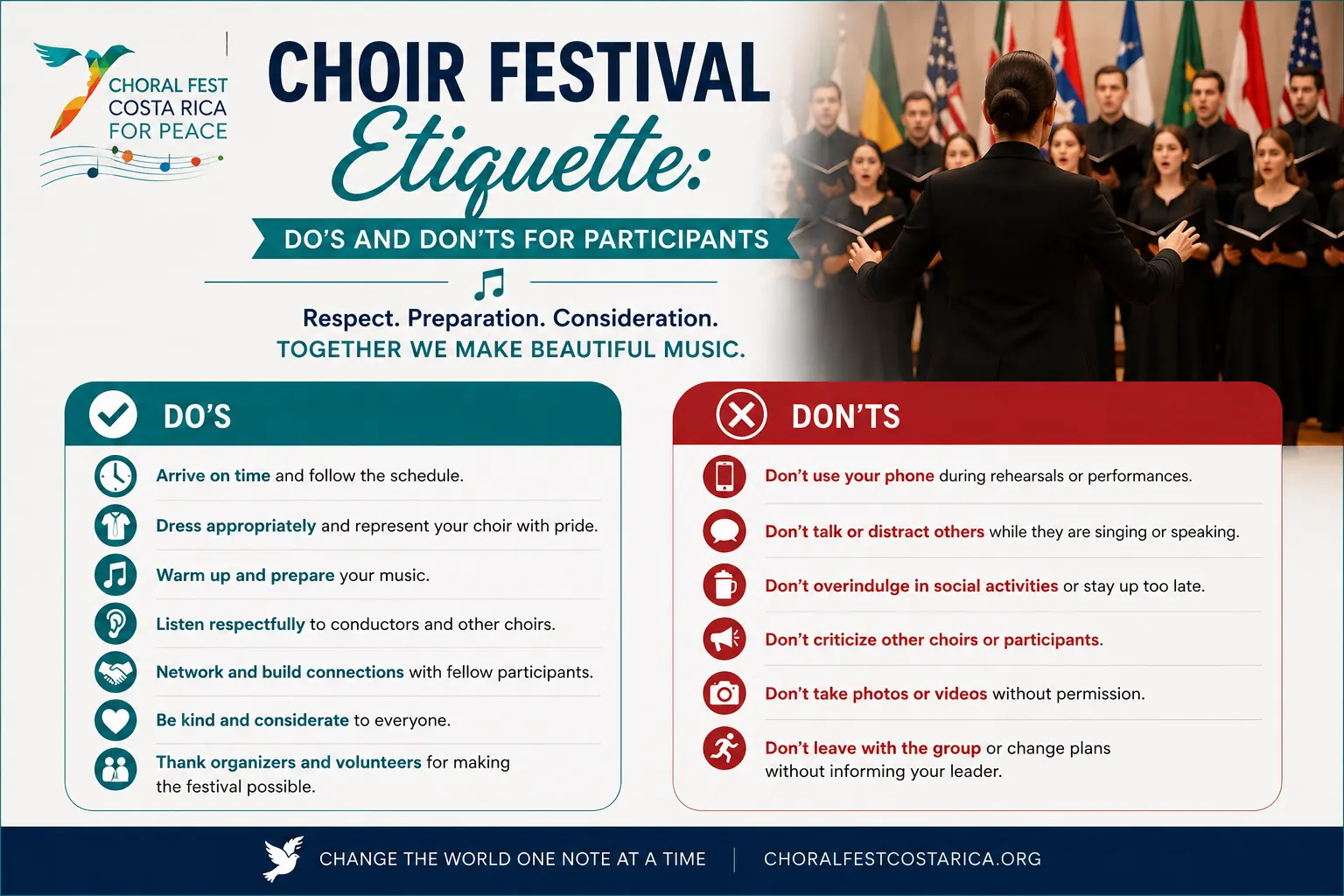
Choir festival etiquette helps singers, directors and companions participate respectfully in rehearsals, concerts, workshops and shared activities. A festival brings together ensembles with different languages, traditions and levels of experience, so punctuality, preparation and consideration for others are essential.
This practical guide explains the main do’s and don’ts for choir festival participants, from following the schedule and respecting performances to managing phones, transportation, accommodation and cultural differences.
Understanding choir festival etiquette helps singers, directors and companions contribute to a respectful, efficient and enjoyable international choral experience.
Choir Festival Etiquette at a Glance
| Do | Don’t |
|---|---|
| Arrive early and follow the official schedule | Delay rehearsals, transportation or performances |
| Wear the requested concert clothing | Change the dress code without informing the director |
| Warm up and prepare your music | Use festival rehearsals for basic note learning |
| Listen respectfully to other choirs | Talk, walk around or use your phone during performances |
| Follow conductors and festival staff | Ignore technical, safety or stage instructions |
| Represent your choir and country positively | Criticize other ensembles publicly |
| Rest, hydrate and protect your voice | Arrive exhausted or vocally unprepared |
| Thank volunteers, hosts and organizers | Treat logistical support as unimportant |
Why Choir Festival Etiquette Matters
Good choir festival etiquette protects rehearsal time, supports performances and helps international participants feel respected.
A choir festival is a shared musical environment. Every ensemble depends on organizers, conductors, accompanists, technicians, guides, drivers, volunteers and host institutions.
Good etiquette helps:
- keep rehearsals and concerts on schedule;
- protect the concentration of performers;
- reduce logistical delays;
- support cultural exchange;
- create a welcoming atmosphere;
- represent each choir professionally;
- strengthen future international relationships.
Festival etiquette is not about excessive formality. It is about helping many people work and make music together successfully.
For a broader practical overview of singing, rehearsals and performance preparation, see the Complete Guide to Choir Singing.
Do Arrive Early
Arriving on time usually means being present before the scheduled starting time.
Singers may need time to:
- check in;
- find the rehearsal room;
- organize scores;
- use restrooms;
- change clothing;
- warm up;
- receive instructions;
- move into the correct formation.
For transportation, rehearsals and performances, follow the arrival time provided by the director or festival staff rather than calculating only the official starting time.
Don’t Delay the Group
One late participant can affect an entire choir, especially when transportation, sound checks or combined rehearsals are involved.
If an unavoidable delay occurs:
- contact the designated choir leader;
- explain the situation briefly;
- follow the instructions provided;
- avoid contacting several organizers with conflicting messages.
Do Follow the Official Schedule
Festival schedules may include:
- rehearsals;
- concerts;
- workshops;
- meals;
- transportation;
- cultural visits;
- sound checks;
- shared-song rehearsals;
- opening and closing ceremonies.
Keep the current schedule available on your phone or in print. Check for official updates from the choir director or festival organization.
Don’t Rely on Unofficial Information
Information shared informally among participants may be incomplete or outdated.
For schedule changes, transportation, venues and performance instructions, rely on:
- the festival coordinator;
- your choir director;
- the designated group leader;
- the official communication channel.
Do Wear the Correct Concert Clothing
Follow the dress code established by the choir and festival.
Confirm:
- concert clothing;
- shoes;
- accessories;
- folder color;
- weather requirements;
- whether changing facilities are available.
Bring essential items in advance rather than depending on last-minute purchases.
Don’t Make Unapproved Changes to the Uniform
Individual changes can affect the visual unity of the ensemble.
Speak with the director beforehand when an adjustment is needed for:
- health;
- mobility;
- religious practice;
- cultural reasons;
- personal safety or comfort.
Do Prepare Your Music Before the Festival
Festival rehearsals are usually designed to coordinate interpretation, staging and combined singing. They are not intended to replace the choir’s preparation at home.
Before traveling, singers should know:
- their notes;
- rhythm;
- text;
- pronunciation;
- breaths;
- cutoffs;
- concert order;
- shared repertoire assigned by the festival.
Our guide to how to read choral music can help singers prepare their scores more effectively. Directors can also connect this preparation with how to organize an effective choir rehearsal.
Don’t Depend Entirely on Other Singers
Every participant should take responsibility for their own part.
A singer who depends completely on the person beside them may become uncertain when:
- the standing formation changes;
- choirs are mixed;
- another singer is absent;
- the acoustic space sounds different;
- the conductor changes the seating or stage arrangement.
Do Warm Up Properly
Use a gentle, purposeful warm-up before rehearsals and performances.
Focus on:
- physical release;
- breathing;
- resonance;
- vowels;
- diction;
- starting pitches;
- difficult entrances.
Avoid exhausting the voice by singing demanding passages repeatedly before the concert.
See our guide to vocal warm-ups for choirs.
Don’t Ignore Vocal Health
Festival schedules can be demanding. Protect your voice by:
- hydrating regularly;
- sleeping sufficiently;
- avoiding unnecessary shouting;
- speaking comfortably;
- reporting pain or significant vocal difficulty;
- following the director’s warm-up plan.
Vocal pain should not be treated as a normal part of participation.
Do Listen Respectfully to Other Choirs
When another ensemble performs:
- remain quiet;
- silence your phone;
- avoid moving unnecessarily;
- wait for appropriate moments to enter or leave;
- applaud respectfully;
- give the performers your attention.
Listening is part of the cultural and educational value of a choir festival.
Don’t Talk During Performances
Whispering, phone use and repeated movement distract performers and nearby audience members.
If you must leave for an urgent reason, wait for applause or follow the instructions of venue staff.
Do Respect Workshops and Conductors
During workshops and combined rehearsals:
- arrive prepared;
- bring the required score;
- watch the conductor;
- avoid private conversations;
- follow instructions promptly;
- ask relevant questions at an appropriate moment.
Participants may encounter conducting or rehearsal styles different from those used by their own choir. Approach the experience with openness and professionalism.
For more on conductor communication, see How to Conduct a Choir.
Don’t Correct Other Singers Without Permission
Helpful intentions can create confusion when several people give different instructions.
Corrections should normally come from:
- the conductor;
- the workshop leader;
- the section leader;
- the singer’s own director.
Offer assistance privately and respectfully when it is genuinely needed.
Do Respect Cultural Differences
Respect for language, customs and personal boundaries is a central part of choir festival etiquette.
International festivals bring together people with different languages, traditions, beliefs and communication styles.
For a broader framework on respectful cultural exchange, see UNESCO’s resources on intercultural dialogue.
Participants should:
- avoid stereotypes;
- ask respectful questions;
- pronounce names carefully;
- respect religious and cultural practices;
- avoid jokes that may be offensive;
- listen before making assumptions.
Don’t Compare Choirs Publicly
A non-competitive festival is not a ranking exercise.
Avoid public comments such as:
- one choir was better than another;
- one tradition is more advanced;
- one director’s style is incorrect;
- a choir’s language or accent sounds strange.
Choirs may have different goals, resources, ages and musical traditions.
Do Use Phones Responsibly
Phones can be useful for schedules, messages and translations, but they should not interrupt festival activities.
During rehearsals, concerts and workshops:
- use silent mode;
- disable unnecessary alerts;
- avoid recording without permission;
- do not take calls in the performance space;
- follow photography and video rules.
Don’t Publish Images Without Considering Consent
Before posting photographs or videos, consider:
- festival media policies;
- venue rules;
- copyright;
- children’s privacy;
- personal consent;
- whether the content could embarrass another participant.
Do Respect Transportation Instructions
Group transportation depends on coordination.
Participants should:
- arrive before departure time;
- use the assigned vehicle;
- inform the group leader before leaving;
- keep aisles clear;
- take personal belongings when exiting;
- follow driver and guide instructions.
Don’t Change Plans Without Informing the Group
Leaving the hotel, venue or activity independently without notice can create safety and logistical concerns.
Follow the communication and permission procedures established by the choir and festival.
Do Respect Hotels and Shared Accommodation
Participants represent their choir even outside rehearsals and concerts.
Choirs preparing for travel can also review How to Prepare Your Choir for an International Festival.
In hotels and shared spaces:
- respect quiet hours;
- avoid singing loudly in hallways;
- follow room-occupancy rules;
- protect hotel property;
- keep common areas clean;
- treat staff respectfully.
Don’t Allow Social Activities to Affect Performance
Festival friendships and social events are valuable, but singers still need rest and preparation.
Avoid:
- very late nights before performances;
- excessive noise;
- activities that cause dehydration or fatigue;
- missing meals or transportation;
- arriving unprepared for the next day.
Do Build Meaningful Connections
Strong choir festival etiquette also means approaching networking as genuine exchange rather than self-promotion.
Choir festivals provide opportunities to meet:
- singers;
- conductors;
- composers;
- teachers;
- organizers;
- local communities;
- future musical partners.
Introduce yourself, ask about other choirs and exchange contact information when appropriate.
Don’t Treat Networking as Promotion Only
Meaningful connections begin with curiosity and listening.
Avoid dominating conversations with:
- advertising;
- requests for favors;
- comparisons;
- constant discussion of your own choir.
Do Show Gratitude
Festivals depend on many people whose work may not appear on stage.
Thank:
- organizers;
- volunteers;
- hosts;
- drivers;
- technicians;
- guides;
- accompanists;
- venue staff;
- local partners.
A sincere verbal thank-you, message or choir acknowledgment can help build lasting relationships.
Don’t Criticize Other Participants Publicly
Public criticism can damage the festival atmosphere and the reputation of your own ensemble.
Concerns involving safety, discrimination, harassment or serious organizational problems should be reported privately through the appropriate channel.
Etiquette for Choir Directors
Directors have additional responsibilities.
They should:
- communicate schedules clearly;
- prepare singers adequately;
- respect rehearsal time limits;
- coordinate with festival staff;
- avoid changing repertoire without approval;
- support participant safety;
- model respectful behavior;
- resolve concerns privately.
Etiquette for Companions and Family Members
Companions also form part of the festival delegation.
They should:
- follow transportation schedules;
- respect rehearsal restrictions;
- avoid interrupting directors or singers;
- observe photography policies;
- support the group’s punctuality;
- follow venue and hotel rules.
Etiquette for Shared-Song Performances
When several choirs perform common repertoire:
- prepare the assigned edition;
- follow the festival conductor;
- respect the agreed tempo and pronunciation;
- do not assume another choir will cover your part;
- watch for entrances and cutoffs;
- follow the assigned formation.
Shared singing works best when every ensemble arrives prepared and flexible.
Common Choir Festival Etiquette Mistakes
- arriving at the official start time instead of the call time;
- talking while another choir performs;
- using phones during rehearsals;
- ignoring clothing instructions;
- learning common repertoire at the festival;
- criticizing other ensembles;
- posting images without permission;
- leaving group activities without informing anyone;
- not resting before performances;
- forgetting to thank organizers and volunteers.
Choir Festival Participant Checklist
- Official schedule saved
- Emergency contact available
- Scores prepared and marked
- Concert clothing complete
- Phone set to silent
- Water bottle and essential medication packed
- Transportation instructions confirmed
- Media and photography rules understood
- Shared repertoire prepared
- Hotel and venue rules reviewed
Frequently Asked Questions About Choir Festival Etiquette
What should singers never do during another choir’s performance?
Avoid talking, using phones, moving unnecessarily, recording without permission or leaving during a quiet passage. Wait for an appropriate break or applause whenever possible.
What should singers pack for a choir festival?
Bring prepared scores, concert clothing, comfortable travel clothes, water, essential medication, identification, schedule information, chargers and any materials required by the director or festival.
How should singers behave in a combined rehearsal?
Arrive early, bring the correct edition, follow the festival conductor, avoid private conversations and adjust quickly to agreed pronunciation, tempo and formation.
Is it appropriate to post festival photos on social media?
Yes when festival, venue and participant policies allow it. Always consider consent, especially when children or private moments are involved.
What should a choir director communicate before international travel?
Directors should clearly explain schedules, call times, dress code, repertoire, transportation procedures, media rules, emergency contacts and expectations for behavior.
How can singers represent their country respectfully at an international festival?
Be curious, punctual, prepared and respectful. Avoid stereotypes and public comparisons, and show genuine interest in the music and traditions of other choirs.
How early should singers arrive for a festival performance?
Follow the official call time, which may be significantly earlier than the concert. Singers need time for check-in, warm-up, sound check and stage preparation.
Can singers record other choirs?
Only when festival, venue and performer policies allow it. Some music, participants or venues may have recording restrictions.
Should singers wear their concert clothing all day?
Follow the festival instructions. In many cases, singers travel in comfortable clothing and change before the performance.
What should a participant do if they are late?
Contact the designated choir leader immediately and follow instructions without disrupting the activity already in progress.
Can participants leave a festival activity independently?
They should follow the choir and festival communication procedures, especially when group transportation or safeguarding is involved.
Is it acceptable to give advice to singers from another choir?
Only when the advice is invited or part of an organized exchange. Unrequested correction may feel disrespectful.
How should participants respond to cultural differences?
Listen, ask respectful questions and avoid stereotypes or public comparisons.
What is the most important rule of choir festival etiquette?
Respect the shared experience: arrive prepared, follow instructions, listen to others and consider how your actions affect the entire festival.
Conclusion
Strong choir festival etiquette is ultimately about preparation, respect and awareness of how individual choices affect the entire shared experience.
Good choir festival etiquette helps singers, directors, companions and organizers create a respectful and enjoyable experience.
Punctuality, preparation, active listening, cultural sensitivity and gratitude allow many ensembles to share music successfully.
Every participant represents their choir both on and off the stage. Small acts of consideration can strengthen the atmosphere of the festival and create relationships that continue long after the final concert.
Experience Choral Fest Costa Rica for Peace
The International Choral Festival in Costa Rica for Peace welcomes choirs to participate in concerts, workshops, cultural exchange and shared singing in a non-competitive environment.
Participating ensembles are invited to bring their own musical identity while helping create a festival based on respect, friendship and peace through choral music.