
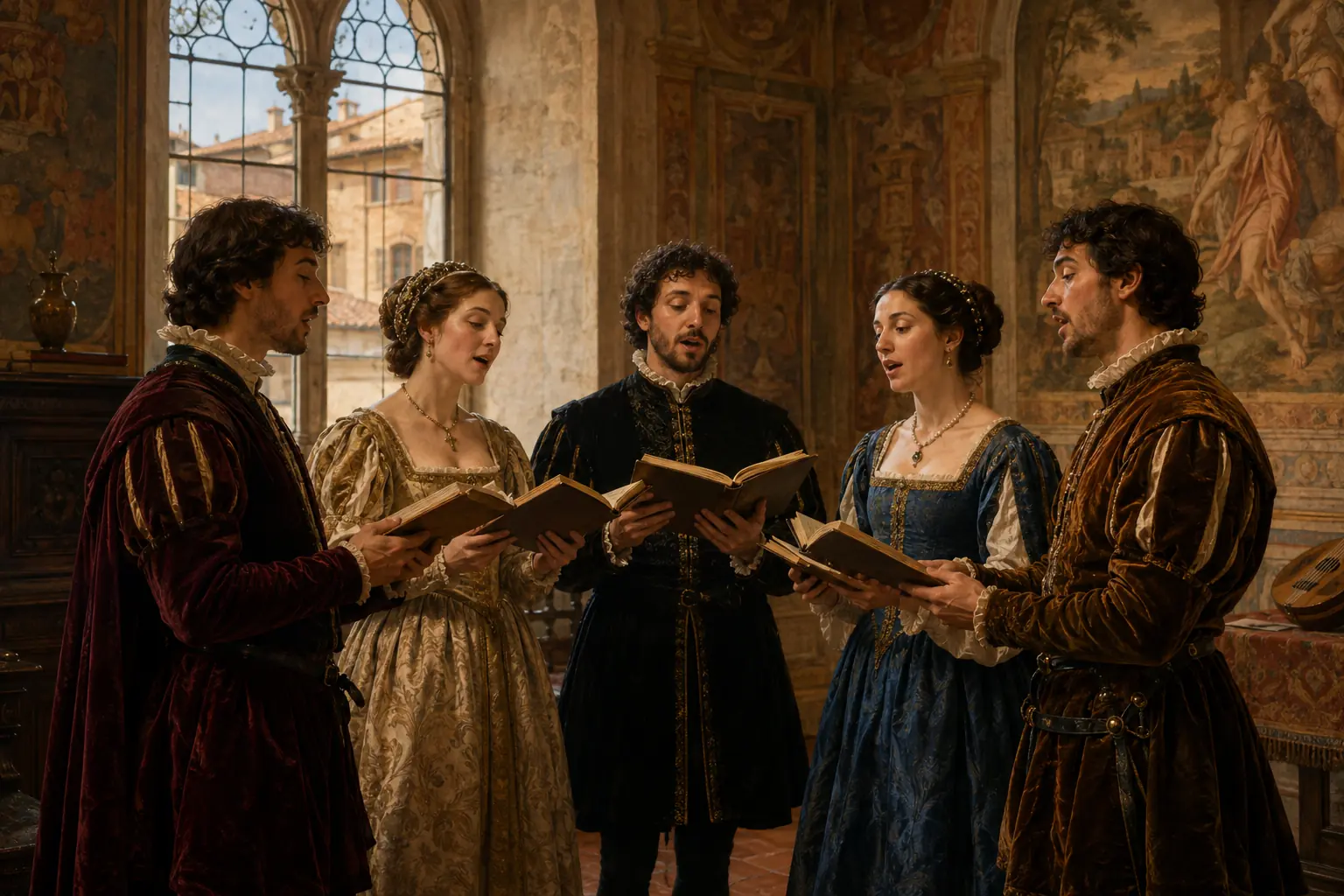
A Renaissance madrigal is a secular vocal composition—usually for several unaccompanied voices—set to poetry in the vernacular language. Madrigals flourished in Italy and later England, combining expressive polyphony, vivid text setting and techniques such as word painting.
This guide explains the origins of the Renaissance madrigal, its musical characteristics, major composers, performance style and lasting influence on choral music.
Renaissance Madrigal at a Glance
| Element | Typical feature |
|---|---|
| Subject | Secular poetry, often love, nature, humor or emotional conflict |
| Language | Italian, English or another vernacular language |
| Texture | Polyphonic, often alternating with chordal passages |
| Forces | Several vocal parts, frequently performed one singer per part or by a small chamber choir |
| Form | Often through-composed |
| Expression | Word painting and close attention to the text |
To place the madrigal within the larger family of Renaissance vocal genres, see Motet vs. Madrigal and Polyphony in Music.
Origins of the Renaissance Madrigal
The Renaissance madrigal emerged in Italy during the early 16th century and became one of the most sophisticated secular vocal forms of the period.
Early madrigals were influenced by Italian secular song traditions, including the frottola, but composers quickly developed more complex textures and more expressive relationships between poetry and music.
Unlike sacred forms such as the motet, madrigals generally set secular poetry and were intended for private, courtly or social performance rather than liturgical worship.
For the wider historical context, see The History of Choral Music and The Evolution of Choral Music.
Main Musical Characteristics of the Renaissance Madrigal
The musical language of the Renaissance madrigal is closely tied to poetry. Composers responded to individual words, emotional shifts and images in the text with changing harmony, texture and rhythm.
Polyphonic Texture
Many madrigals use several independent melodic lines. Voices imitate, answer and overlap one another, creating a woven musical texture.
Through-Composed Form
Many madrigals are through-composed, meaning that new music appears as the poetry develops instead of repeating a simple verse-and-chorus structure.
Vernacular Language
Unlike much sacred Renaissance music, which often used Latin, madrigals commonly used Italian, English or other spoken languages of the period.
Small Vocal Forces
Madrigals were often written for relatively small ensembles. Modern choirs may perform them one singer per part or with several singers on each line.
Word Painting and Text Expression
One of the most famous features of the Renaissance madrigal is word painting, sometimes called text painting.
Word painting occurs when the musical gesture reflects the literal or emotional meaning of the text. Examples may include:
- rising melodic lines for words such as “ascend” or “heaven”;
- descending figures for “fall,” “death” or “sorrow”;
- rapid notes for movement, laughter or excitement;
- chromatic harmony for pain or emotional instability;
- long sustained notes for words connected with eternity or stillness;
- sudden rests for silence, interruption or surprise.
This close relationship between language and music helped make the madrigal one of the most expressive vocal genres of the Renaissance.
Famous Renaissance Madrigal Composers
Claudio Monteverdi
Monteverdi stands at the transition between the Renaissance and Baroque periods. His madrigals expanded harmonic language and dramatic expression, especially in his later collections.
Carlo Gesualdo
Gesualdo is known for unusually intense chromatic harmony and dramatic text expression. His madrigals often contain sudden harmonic shifts that remain striking to modern listeners.
Luca Marenzio
Marenzio became famous for elegant text painting and sensitive treatment of Italian poetry. His madrigals strongly influenced later composers.
Philippe Verdelot
Verdelot was important in the early development of the Italian madrigal and helped establish the genre during the first half of the 16th century.
Jacques Arcadelt
Arcadelt wrote accessible and lyrical madrigals that became widely circulated throughout Europe.
Thomas Morley
Morley became one of the best-known English madrigal composers and helped adapt the Italian tradition to English language, taste and performance culture.
Italian and English Madrigals
Italian Madrigal
The Italian madrigal generally became more adventurous in harmony, poetry and expressive technique over the 16th century.
Later Italian madrigals could be highly chromatic, dramatic and emotionally intense.
English Madrigal
English composers adopted the genre later and often favored lighter, more pastoral or playful subjects.
Thomas Morley, John Wilbye and Thomas Weelkes are among the most important English madrigal composers.
English madrigals may include lively rhythmic writing, repeated syllables and cheerful refrains such as “fa-la-la,” although not every English madrigal uses this style.
How Renaissance Madrigals Are Performed
Madrigals are frequently performed a cappella today, although historical practice could vary depending on place, period and available musicians.
A successful performance should balance independence and ensemble unity.
Singers should pay attention to:
- clear diction;
- independent entrances;
- balanced polyphonic lines;
- word painting;
- dynamic hierarchy;
- vowel consistency;
- intonation in close harmony;
- the emotional meaning of the text.
For practical preparation, see How to Sing in Harmony, Choir Blend and Balance and How to Improve Choir Intonation.
Influence of the Madrigal on Later Choral Music
The influence of the Renaissance madrigal extends far beyond the 16th century.
Its legacy can be heard in:
- expressive text setting;
- dramatic harmony;
- imitative vocal writing;
- through-composed form;
- small-ensemble vocal writing;
- close attention to poetry and language.
Monteverdi’s later madrigals also helped prepare the way for early Baroque dramatic styles and the development of opera.
Modern choral composers continue to use word painting, layered texture and expressive harmonic color in ways that reflect techniques developed in Renaissance vocal music.
Tips for Singers and Directors Exploring Madrigals
Study the Text First
Translate unfamiliar words, identify emotional changes and mark important images before rehearsing details of phrasing.
Learn Parts Independently
Polyphonic music requires each section to maintain its own melody and rhythm. Sectionals are especially useful.
Rehearse Imitative Entrances
Identify which voice introduces each phrase and where the next section imitates it.
Balance the Lines
Do not let one section dominate continuously. Musical priority should move according to the text and counterpoint.
Reduce Piano Dependence
Once notes are secure, rehearse without constant doubling so singers can hear the complete harmonic texture.
Connect Repertoire to Historical Context
Understanding the poetry, language and cultural setting can make the performance more convincing.
Directors choosing madrigals can also use How to Choose Music for Your Choir and Choir Repertoire Planning.
Frequently Asked Questions About the Renaissance Madrigal
What is a Renaissance madrigal?
A Renaissance madrigal is a secular vocal composition, usually for several voices, that sets poetry in a vernacular language and often uses polyphony and word painting.
Are madrigals sacred or secular?
Renaissance madrigals are primarily secular, although composers sometimes used spiritual or moral poetry outside formal liturgical settings.
Were madrigals sung a cappella?
They are often performed a cappella today, although instruments could double or substitute vocal lines in some historical contexts.
What is word painting in a madrigal?
Word painting is a technique in which the music illustrates the literal or emotional meaning of the text.
Who were the most famous madrigal composers?
Important composers include Claudio Monteverdi, Carlo Gesualdo, Luca Marenzio, Jacques Arcadelt, Philippe Verdelot, Thomas Morley and Thomas Weelkes.
What is the difference between a motet and a madrigal?
A Renaissance motet is generally sacred and often uses Latin text, while a madrigal is usually secular and uses vernacular poetry.
What is the difference between Italian and English madrigals?
Italian madrigals often became more harmonically adventurous and dramatic, while English madrigals frequently favored lighter texts, pastoral subjects and lively rhythmic writing.
Why are madrigals important in music history?
They helped develop expressive text setting, chromatic harmony, dramatic vocal writing and techniques that influenced early Baroque music and opera.
Are madrigals difficult to sing?
They can be challenging because singers must maintain independent lines, tune close harmony, coordinate text and listen carefully to imitative entrances.
Can modern choirs perform Renaissance madrigals?
Yes. Chamber, school, university, community and professional choirs regularly perform madrigals in concerts and educational programs.
Conclusion
The Renaissance madrigal remains one of the most expressive and influential forms of secular choral music.
Its combination of poetry, polyphony, word painting and emotional detail gives singers a unique opportunity to connect language and music at a very high level.
For the broader historical and practical framework, explore Polyphony in Music, Motet vs. Madrigal and the Complete Guide to Choir Singing.
Rediscover the Madrigal Tradition at Choral Fest Costa Rica
Renaissance gems like the madrigal find new life when choirs from around the world gather at the International Choral Festival in Costa Rica for Peace, a non-competitive celebration of music, culture and peace.
Apply with your choir → or explore the festival to learn more.