
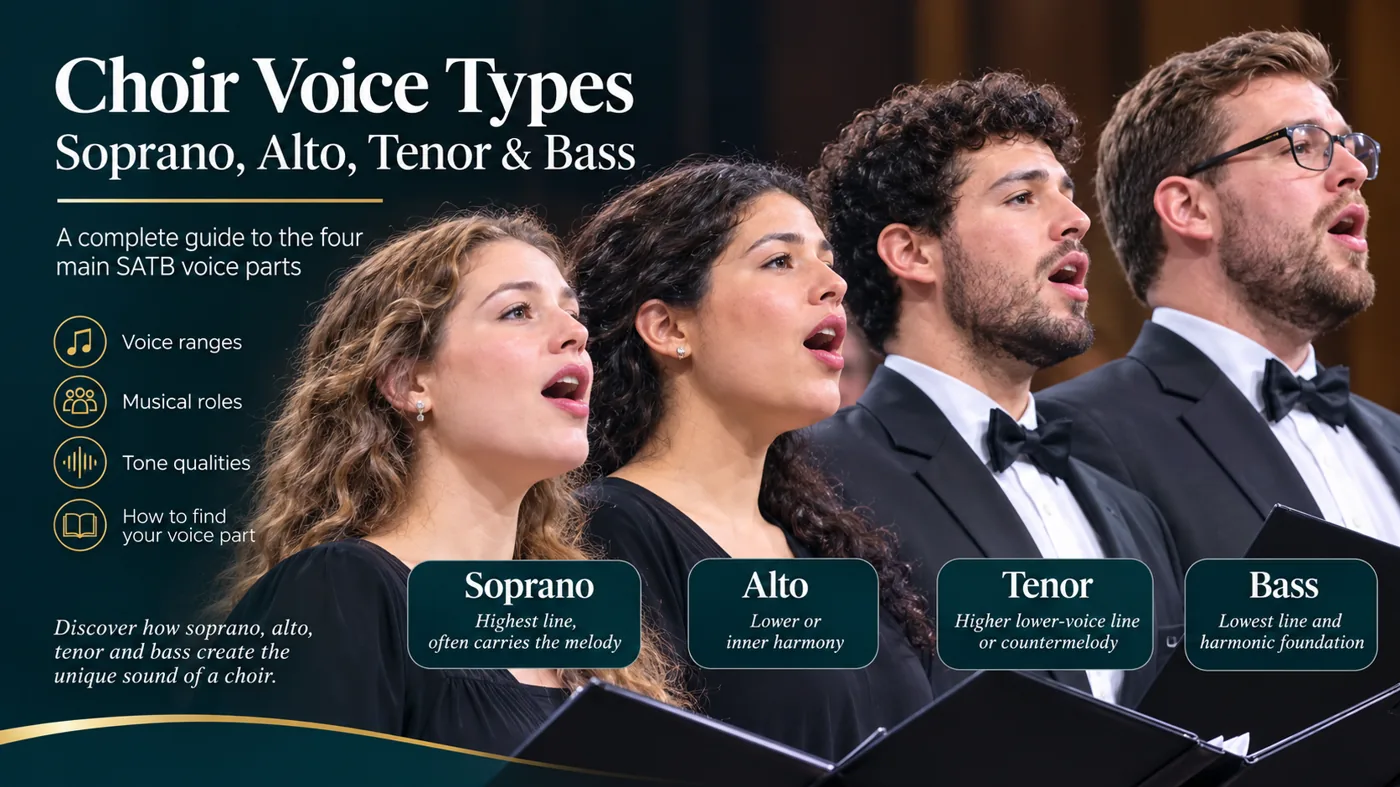
Choir voice types are commonly organized into four principal parts: soprano, alto, tenor and bass, usually abbreviated SATB. Soprano carries the highest line, alto usually provides lower or inner harmony, tenor supplies the higher lower-voice part, and bass anchors the ensemble.
This guide explains the approximate ranges, tone qualities and musical roles of the four main choir voice types, while recognizing that comfortable range, tessitura and vocal color vary from singer to singer.
Choir Voice Types at a Glance
| Part | Approximate choral range | Typical role |
|---|---|---|
| Soprano | C4–A5 | Highest line; often carries the melody |
| Alto | G3–D5 | Lower or inner harmony |
| Tenor | B2–A4 | Higher lower-voice line or countermelody |
| Bass | E2–E4 | Lowest line and harmonic foundation |
These ranges are approximate. Choral parts vary by composer, arrangement, style, training and individual comfort.
For a more detailed look at how the four parts function together in mixed-voice repertoire, see SATB Voice Parts: Soprano, Alto, Tenor & Bass.
Soprano
The soprano is usually the highest of the standard choir voice types. In many SATB arrangements, sopranos carry the principal melody, although the melody can move to any section.
Typical characteristics:
- Approximate choral range: C4 to A5
- Often sings the highest line
- May carry melody, descant or upper harmony
- Requires clarity and freedom in the upper register
Soprano tone can vary greatly depending on age, training and repertoire. A choir should not expect every soprano to produce the same vocal color.
Alto
The alto is the lower treble or upper inner part in SATB writing. Altos frequently sing inner harmony, sustained chord tones and lines that connect the soprano and tenor parts.
Typical characteristics:
- Approximate choral range: G3 to D5
- Often sings inner harmony
- Frequently carries thirds, suspensions and supporting tones
- Requires strong part independence
Because alto lines are often less melodically obvious, singers may need especially strong interval awareness and harmonic listening. Our guide to How to Sing in Harmony includes exercises for this skill.
Tenor
The tenor is the higher lower-voice part in traditional SATB writing. Tenors may sing melody, countermelody, inner harmony or exposed entrances depending on the repertoire.
Typical characteristics:
- Approximate choral range: B2 to A4
- Often carries an upper lower-voice line
- May connect inner harmony with the bass foundation
- Often requires flexibility through the upper part of the range
Tenor sections can include singers with different vocal identities and techniques. What matters most in choir placement is whether the singer can perform the part comfortably, consistently and healthily.
Bass
The bass is usually the lowest of the four main choir voice types. Basses provide harmonic foundation, define many root movements and help establish tonal stability.
Typical characteristics:
- Approximate choral range: E2 to E4
- Usually sings the lowest line
- Provides harmonic and rhythmic foundation
- May carry melody or countermelody in some works
A strong bass section does not need to sing heavily. Clear pitch, resonance, rhythm and text are often more useful than simply producing greater volume.
Why Understanding Choir Voice Types Matters
Understanding choir voice types helps singers and directors make better musical decisions.
- Balance: each section contributes a different register and harmonic function.
- Blend: knowing the role of each section helps singers adjust tone and volume intelligently.
- Vocal comfort: singers perform more consistently when repertoire fits their usable range and tessitura.
- Harmony: SATB writing depends on the relationship among the four voice parts.
- Repertoire planning: directors can choose music that fits the actual strengths of the ensemble.
For practical ensemble work, continue with Choir Blend and Balance and How to Improve Choir Intonation.
How to Identify Your Choir Voice Type
Finding your choir part involves more than identifying the highest and lowest notes you can produce.
1. Find Your Comfortable Range
Use a piano, keyboard or qualified teacher to identify the lowest and highest notes you can sing comfortably without forcing.
2. Pay Attention to Tessitura
Tessitura is the part of the range where your voice can sing comfortably for an extended period. Two singers may reach the same notes but feel most comfortable in different areas.
3. Notice Tone and Registration
Listen to where the voice feels free, resonant and sustainable. Avoid choosing a section only because one extreme note is possible.
4. Sing With the Choir
Try the actual repertoire. A voice part that feels comfortable in isolation may feel different when sung for an entire rehearsal.
5. Ask the Director or Voice Teacher
A conductor or qualified voice teacher can help assess range, tessitura, stamina and section suitability.
Directors working with new singers may also use Choir Auditions Explained when assigning sections.
Vocal Range and Tessitura Are Not the Same
Range describes the total span of notes a singer can produce. Tessitura describes the part of that range where the voice functions most comfortably and consistently.
This distinction matters because choir placement should not be based only on extreme notes. A singer who can reach a high note once may not be comfortable singing near that pitch for an entire rehearsal or concert.
Healthy section placement should consider:
- comfortable sustained range;
- repertoire demands;
- vocal stamina;
- register transitions;
- tone quality;
- ensemble balance.
Voice Types Beyond SATB
Not every choir uses only four parts. Music may divide voices into additional sections such as:
- Soprano 1 and Soprano 2
- Alto 1 and Alto 2
- Tenor 1 and Tenor 2
- Bass 1 and Bass 2
- Mezzo-soprano
- Baritone
- Treble or unchanged voices
Children’s, youth, treble, cambiata, chamber and professional choirs may use different systems depending on age, repertoire and vocal development.
For a closer look at two frequently discussed categories, see Baritone and Mezzo-Soprano in Choir.
Practical Tips for Choir Singers
- Warm up gradually: use Vocal Warm-Ups for Choirs before demanding repertoire.
- Use efficient breathing: review Breathing Techniques for Choir Singers.
- Learn your role: understand whether your section carries melody, harmony or bass foundation.
- Listen across the choir: do not sing only against the person beside you.
- Avoid forcing range extremes: tell the director if a passage causes repeated discomfort.
- Practice independently: prepare notes, rhythm and entrances before rehearsal.
For the larger practical framework, see the Complete Guide to Choir Singing.
Frequently Asked Questions About Choir Voice Types
What are the four main choir voice types?
The four standard SATB parts are soprano, alto, tenor and bass.
What does SATB stand for?
SATB stands for soprano, alto, tenor and bass.
Which choir voice type usually sings the melody?
Soprano often carries the melody in traditional SATB music, but melody can move to alto, tenor or bass depending on the composition.
What is the difference between alto and mezzo-soprano?
Alto is usually a choral part, while mezzo-soprano is more often used as a solo voice classification. Some mezzo-soprano singers perform alto parts in choirs.
What is the difference between tenor and baritone?
Tenor is the higher lower-voice part in SATB writing. Baritone generally lies between tenor and bass and may sing either tenor or bass material depending on the arrangement and singer.
Can a singer change choir sections?
Yes. Voice placement can change with age, training, repertoire, vocal development and the needs of the ensemble.
How do I know whether I am soprano or alto?
Do not judge only by the highest note you can sing. Consider comfortable tessitura, tone, stamina and how the part feels across a complete rehearsal.
How do I know whether I am tenor or bass?
Compare your comfortable range and tessitura in actual repertoire. A conductor or voice teacher can help determine where your voice functions most freely and consistently.
Are choir ranges the same for every singer?
No. Published ranges are approximations. Individual voices vary widely, and composers may write outside the most common ranges.
Why are altos and tenors often harder to hear?
They frequently occupy the inner harmony between soprano and bass. Directors may need to adjust balance so those lines remain clear.
Conclusion
Understanding choir voice types helps singers and directors organize SATB music more effectively while protecting vocal comfort and improving ensemble balance.
Soprano, alto, tenor and bass each contribute a different register and musical function. The goal is not to force singers into rigid categories, but to place each voice where it can contribute comfortably, consistently and musically.
Hear These Voice Types Come Together at Choral Fest Costa Rica
Sopranos, altos, tenors and basses from choirs around the world blend their voices at the International Choral Festival in Costa Rica for Peace, a non-competitive gathering built around cultural exchange, connection and a shared message of peace.
Apply with your choir → or explore the festival to learn more.