
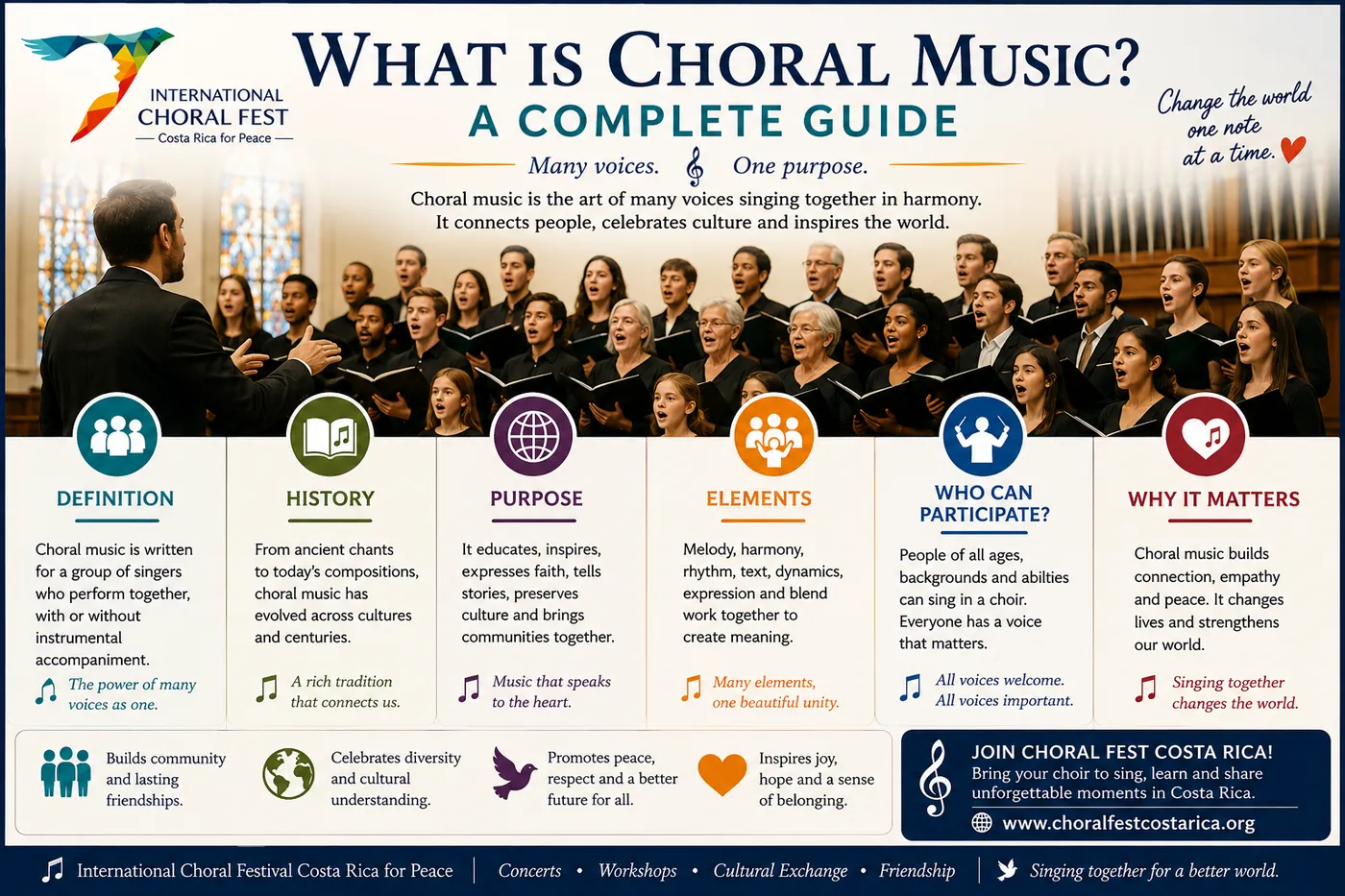
Choral music is music written or arranged for a group of singers who perform together. The singers may use one shared melodic line or several independent voice parts that combine to create harmony, counterpoint, rhythm and expressive meaning.
Choral music can be sacred or secular, accompanied or a cappella, simple or highly complex. It is performed by children’s choirs, school ensembles, community groups, chamber choirs, university choirs, professional singers and large festival choruses around the world.
Understanding what is choral music becomes easier when we look at its voice parts, textures, forms, history, repertoire and the different communities that bring it to life.
What Is Choral Music at a Glance?
| Element | Meaning in choral music |
|---|---|
| Voices | Two or more singers performing together |
| Voice parts | Unison, soprano, alto, tenor, bass or other combinations |
| Texture | Monophonic, homophonic or polyphonic writing |
| Accompaniment | A cappella or supported by piano, organ, orchestra or other instruments |
| Texts | Sacred, secular, poetic, dramatic, traditional or contemporary |
| Settings | Churches, schools, concert halls, theaters, communities and festivals |
| Main purpose | Worship, education, artistic expression, storytelling, community and cultural exchange |
| Leadership | Usually guided by a conductor or choir director |
What Makes Music Choral?
Music becomes choral when it is created for a group of singers rather than only one individual voice. The singers may perform the same melody, divide into sections or sing several independent lines at the same time.
A choral composition usually depends on coordination. Singers must agree on pitch, rhythm, pronunciation, breathing, dynamics, articulation and musical direction.
The sound is collective, but every individual remains responsible for listening and contributing accurately to the ensemble.
For a broader practical pathway into singing, rehearsals, SATB, blend, intonation and performance, explore our Complete Guide to Choir Singing.
The Main Elements of Choral Music
Melody
Melody is the musical line listeners often recognize most easily. In some works, the soprano section carries the principal melody. In others, the melody moves between sections or appears in imitation.
Harmony
Harmony is created when different notes sound together. Choral harmony may be simple and chordal or highly complex, depending on the style and historical period.
Rhythm
Rhythm organizes musical time. Choirs must coordinate entrances, consonants, note lengths, rests and changes of tempo with precision.
Text
Words are central to most choral music. The text may come from religious writings, poetry, drama, folk traditions, historical documents or contemporary literature.
Dynamics
Dynamics shape the intensity of the performance. A choir may move from a quiet, intimate sound to a powerful climax while maintaining balance and vocal health.
Blend and Balance
Blend describes how individual voices combine into a unified ensemble sound. Balance refers to the relative strength of sections and musical lines.
Expression
Expression connects musical technique with meaning. Singers use phrasing, color, articulation and dynamics to communicate the emotional character of the text.
Common Choral Voice Parts
Mixed choirs are often organized as SATB:
- Soprano: the highest choral section.
- Alto: the lower treble or upper inner section.
- Tenor: the higher lower-voice section.
- Bass: the lowest choral section.
Other common voicings include unison, SA, SSA, SSAA, SAB, TB and TTBB.
Our guide to SATB voice parts explains soprano, alto, tenor and bass in greater detail.
Choral Music Can Be Unison, Homophonic or Polyphonic
Unison
In unison singing, all singers perform the same melodic line. The music may still sound rich because of differences in octave, vocal color and resonance.
Homophony
In homophonic music, the voice parts usually move together in similar rhythm. This allows the words and chord progression to remain clear.
Polyphony
Polyphony combines several independent melodic lines. Each section has its own musical direction, yet the parts form one complete texture.
Renaissance motets and madrigals provide important examples of polyphonic writing. Their differences are explored in our guide to motet vs. madrigal.
A Cappella and Accompanied Choral Music
A cappella choral music is performed without instrumental accompaniment. The choir supplies the complete melody, harmony and rhythm through the human voice.
Accompanied choral music may use piano, organ, chamber ensemble, orchestra, percussion or other instruments.
Neither format is inherently better. A cappella singing places special demands on tuning and independence, while accompanied music requires close coordination between singers, conductor and instrumentalists.
See our full comparison of A Cappella vs. Accompanied Choir.
Sacred and Secular Choral Music
Sacred choral music is connected to religious texts, worship or spiritual reflection. It includes hymns, psalms, motets, Masses, cantatas, Passions and oratorios.
Secular choral music uses nonreligious subjects such as love, nature, history, humor, community, work, celebration and human experience.
Both sacred and secular music have shaped the development of the choral tradition.
Explore these categories in more detail in Types of Choral Music.
A Brief History of Choral Music
Group singing existed in many ancient cultures as part of worship, storytelling, ceremony and communal life.
In the Western written tradition, Gregorian chant became an important form of medieval sacred music. These chants were generally monophonic, using one unaccompanied melodic line.
Medieval composers gradually developed polyphony. During the Renaissance, sacred motets and secular madrigals demonstrated increasingly refined relationships among independent voices.
The Baroque period expanded the use of choirs, soloists and instruments in cantatas, Passions and oratorios. Handel’s Messiah and the choral works of Johann Sebastian Bach remain central to the repertoire.
Classical and Romantic composers created large Masses, Requiems, oratorios and choral symphonies. The 20th and 21st centuries introduced new harmonies, vocal effects, global influences and digital collaboration.
Explore the full development in our articles about the history of choral music and the evolution of choral music.
Important Forms of Choral Music
Motet
A motet is generally a sacred polyphonic vocal work, especially associated with the Medieval and Renaissance periods.
Madrigal
A madrigal is usually a secular vocal composition based on poetry and expressive text setting.
Mass
A Mass sets sections of the Christian liturgy, often including the Kyrie, Gloria, Credo, Sanctus and Agnus Dei.
Cantata
A cantata is a multi-movement vocal composition for soloists, choir or both, usually with instrumental accompaniment.
Oratorio
An oratorio is normally a large-scale narrative work for choir, soloists and orchestra, performed without theatrical staging.
Requiem
A Requiem is a musical setting connected to the Mass for the dead or a broader reflection on mortality, remembrance and consolation.
Choral Symphony
A choral symphony combines symphonic form with voices. Beethoven’s Ninth Symphony is one of the most influential examples.
The differences between two major Baroque forms are explained in our comparison of oratorio vs. cantata.
Types of Choirs
Choral music is performed by many types of ensembles:
- children’s choirs;
- youth choirs;
- school choirs;
- university choirs;
- community choirs;
- church choirs;
- chamber choirs;
- professional choirs;
- opera choruses;
- gospel choirs;
- show choirs;
- senior choirs;
- virtual choirs.
Learn more in our complete guide to the types of choirs.
Choir vs. Chorus
The words choir and chorus often describe the same basic idea: a group of singers performing together.
Choir is the broadest international term. Chorus is especially common for large ensembles, opera groups, musical theater and the repeated section of a song.
See our full explanation of choir vs. chorus.
The Role of the Choir Director
A choir director or conductor guides the musical and organizational work of the ensemble.
Responsibilities may include:
- selecting repertoire;
- planning rehearsals;
- teaching vocal technique;
- developing rhythm and intonation;
- shaping interpretation;
- coordinating accompanists and instrumentalists;
- preparing concerts and tours;
- supporting a respectful ensemble culture.
The conductor communicates through gesture, rehearsal language, musical preparation and personal leadership.
Directors can continue with How to Conduct a Choir and How to Organize an Effective Choir Rehearsal.
What Skills Do Choir Singers Need?
Singers do not always need advanced training before joining a choir. Many ensembles welcome beginners.
Useful skills include:
- matching pitch;
- maintaining a steady rhythm;
- listening to other sections;
- following a conductor;
- reading words and music;
- breathing efficiently;
- singing with clear diction;
- holding an independent part;
- responding to feedback;
- supporting the ensemble.
These abilities develop through consistent rehearsal and experience.
For practical training, see How to Read Choral Music, Vocal Warm-Ups for Choirs and How to Sing in Harmony.
Why Choral Music Matters
Choral music creates a space where individual voices become part of a shared artistic result.
Singers must listen, adjust and cooperate. This makes choir participation both a musical and social practice.
Choirs can:
- build friendships and belonging;
- preserve language and cultural memory;
- support education and personal confidence;
- create opportunities for intergenerational participation;
- bring communities together;
- encourage cultural exchange;
- give public voice to important stories and values.
Choral Music and Cultural Exchange
Every region has its own vocal traditions, languages, rhythms and approaches to ensemble singing.
International choral encounters allow singers to share repertoire and learn how other communities use music to express identity, history and hope.
Respectful cultural exchange requires accurate pronunciation, proper attribution and an understanding of the context behind each piece.
For repertoire decisions, use How to Choose Music for Your Choir and Choir Repertoire Planning.
Choral Music and Peace
Singing cannot resolve conflict by itself, but it can create opportunities for listening, cooperation and human connection.
A choir asks participants to breathe together, respond to one another and contribute to a collective result without eliminating individual difference.
This principle is explored further in our article about choirs for peace.
How to Begin Exploring Choral Music
- Attend a live concert: Listen to how voices interact in an acoustic space.
- Join a local choir: Look for school, church, university or community ensembles.
- Compare historical periods: Hear Gregorian chant, Renaissance polyphony, Baroque oratorios and contemporary works.
- Follow the text: Read the translation or libretto while listening.
- Learn your voice part: Understand how your line fits into the complete harmony.
- Participate in a workshop: Work with conductors and singers from different backgrounds.
- Attend a choral festival: Experience multiple choirs, styles and cultures in one event.
Frequently Asked Questions About Choral Music
What is choral music?
Choral music is music written or arranged for a group of singers who perform together in unison or in multiple voice parts.
What is the difference between choral music and vocal music?
Vocal music includes all music involving the human voice, including solo singing. Choral music specifically involves a group of singers.
Does choral music always use harmony?
No. Some choral music is sung in unison or uses a single melodic line. Other works use harmony, counterpoint or several independent parts.
Can choral music be performed without instruments?
Yes. Music performed without instrumental accompaniment is called a cappella.
What are the four main choir voice parts?
The four principal SATB sections are soprano, alto, tenor and bass.
Is choral music always religious?
No. Choral music can be sacred or secular and may explore worship, love, nature, history, community, politics or everyday life.
Can beginners sing in a choir?
Yes. Many community, church and educational choirs welcome beginners and teach vocal and musical skills during rehearsals.
Why is choral music important?
Choral music combines artistic expression with listening, cooperation, education, cultural memory and social connection.
What is the difference between choral music and choir music?
The terms are often used interchangeably. Choral music refers to music written or arranged for a group of singers, while choir music is a more informal phrase for music performed by a choir.
What are the three main textures in choral music?
The most common broad textures are monophonic or unison singing, homophony, where voices move together rhythmically, and polyphony, where several independent melodic lines are heard at once.
What is the difference between a choir and an ensemble?
A choir is specifically a vocal ensemble. The word ensemble is broader and can describe vocal, instrumental or mixed groups.
What is the oldest type of choral music?
Group singing existed long before written notation. In the Western written tradition, Gregorian chant is among the most influential early documented forms of sacred ensemble singing.
What is the difference between a motet and a madrigal?
A motet is usually sacred and a madrigal is usually secular, especially in Renaissance repertoire. Their text, function and style differ even though both may use polyphonic writing.
What is the difference between a cantata and an oratorio?
Both are multi-movement vocal forms that may include choir, soloists and instruments. Oratorios are usually larger and more narrative, while cantatas are often shorter and more varied in purpose.
Can choral music include instruments?
Yes. Choral music may be a cappella or accompanied by piano, organ, chamber ensemble, orchestra, percussion or other instruments.
What makes choral music different from solo singing?
Choral music depends on coordinated ensemble decisions. Singers must align pitch, rhythm, text, vowels, dynamics and phrasing while maintaining awareness of other voice parts.
What type of choral music is easiest for beginners?
Unison songs, simple two-part works and accompanied music with comfortable ranges are often useful starting points, although the best choice depends on the age and experience of the singers.
Why is choral music important in cultural exchange?
Choirs carry language, repertoire, stories and musical traditions across communities. International encounters can create opportunities to learn from different performance practices and cultural perspectives.
Conclusion
Understanding what is choral music reveals how voice, text, history, culture and collaboration come together in one of the world’s most enduring forms of collective music-making.
Choral music is the art of combining human voices into a shared musical expression. It may be simple or complex, ancient or contemporary, sacred or secular, accompanied or a cappella.
Its lasting power comes from the relationship between individual and collective sound. Every singer contributes a distinct voice while listening and responding to the whole ensemble.
Across schools, churches, concert halls, communities and international festivals, choral music continues to educate, inspire and connect people.
Experience Choral Music in Costa Rica
The International Choral Festival in Costa Rica for Peace welcomes choirs from different countries, ages, traditions and musical styles.
The festival offers a non-competitive setting for concerts, workshops, cultural exchange and friendship through music.
Apply with your choir → or explore Choral Fest Costa Rica to learn more.